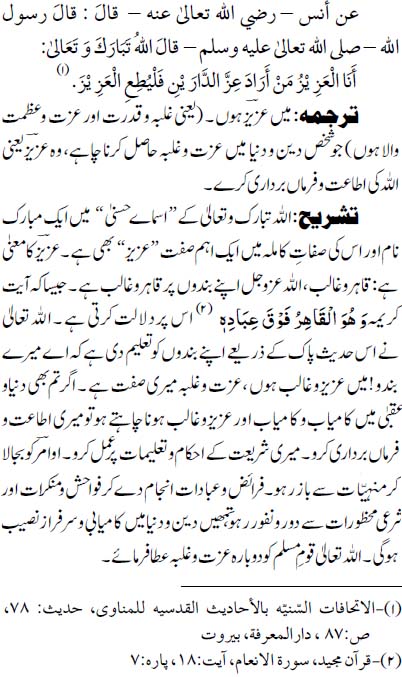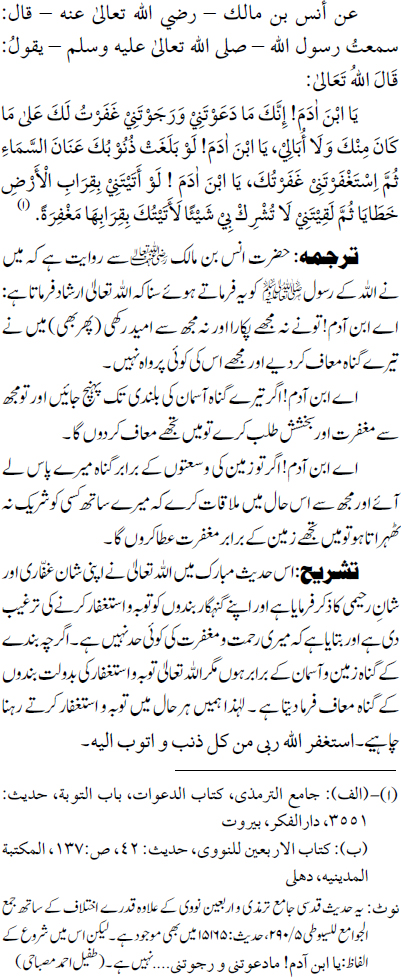
Hadith Qudsi: Allah Ki Rehmat, Maghfirat, Shan-e-Ghafari Aur Shan-e-Raheemi
TAG: Allah
Allah’s Response To The Believer
In the Name of Allah, the Most Gracious, the Most Merciful. [Quran 1:1]
When Allah’s sincere servant says: All praise belongs to Allah, the Lord of the universe! [Quran 1:2]
Allah the Highest says: My servant has Praised Me.
When Allah’s sincere servant says: The most Merciful, the Most Beneficent! [Quran 1:3]
He (Allah the Most High) says: My servant has lauded Me.
When Allah’s sincere servant says: Master of the Day of Judgment! [Quran 1:4]
He (Allah the highest) says: My servant has glorified Me. [My servant entrusted (his affairs) to Me.]
When Allah’s sincere servant says:
You alone do we worship, and You alone do we ask for help! [Quran 1:5]
He (Allah the highest) says: This is Between Me and My servant, and My servant will receive what he asks for.
When Allah’s sincere servant says:
Guide us to the Straight Path! The path of those upon whom You have bestowed Your blessings! Not the path of those who earned Your wrath, or erred and went astray. [Quran 1:6-7]
He (Allah the highest) says: This is for My servant, and My servant will receive what he asks for.
The Prophet (peace be upon him) has said:
[Muslim, Book #004, Hadith #0775] “Abu Huraira reported: The Apostle of Allah (may peace Be upon him) said: If anyone observes prayer in which he does not recite Umm al-Qur’an, It is deficient [he said this three times] and not complete. It was said to Abu Huraira: At times we are behind the Imam. He said: Recite it inwardly, for he had heard the Messenger of Allah (may peace Be upon him) declare that Allah the Exalted had said: I have divided the prayer into two halves Between Me and My servant, and My servant will receive what he asks. When the servant says: Praise Be to Allah, the Lord of the universe, Allah the Highest says: My servant has Praised Me. And when he (the servant) says: The Most Compassionate, the Merciful, Allah the Highest says: My servant has lauded Me. And when he (the servant) says: Master of the Day of judgment, He remarks: My servant has glorified Me. and sometimes He would say: My servant entrusted (his affairs) to Me. And when he (the worshiper) says: Thee do we worship and of Thee do we ask help, He (Allah) says: This is Between Me and My servant, and My servant will receive what he asks for. Then, when he (the worshiper) says: Guide us to the straight path, the path of those to whom Thou hast Been Gracious not of those who have incurred Thy displeasure, nor of those who have gone astray, He (Allah) says: This is for My servant, and My servant will receive what he asks for. Sufyan said: ‘Ala b. ‘Abd al-Rahman b. Ya’qub narrated it to me when I went to him and he was confined to his home on account of illness, and I asked him about it.”
[Malik’s Muwatta, Book #3, Hadith #3.10.41] “Yahya related to me from Malik from al-Ala ibn Abd ar-Rahman ibn Ya’qub that he heard Abu’s-Sa’ib, the mawla of Hisham ibn Zuhra, says he had heard Abu Hurayra say, “I heard the Messenger of Allah, may Allah bless him and grant him peace, say, ‘Whoever prays a prayer without reciting the umm al-Qur’an in it, his prayer is aborted, it is aborted, it is aborted, incomplete.’ So I said, ‘Abu Hurayra, sometimes I am behind the imam. ‘He pulled my forearm and said, ‘Recite it to yourself, O Persian, for I heard the Messenger of Allah, may Allah bless him and grant him peace, say that Allah the Blessed, the Exalted, said, “I have divided the prayer into two halves Between me and my slave. One half of it is for Me and one half of it is for My slave, and My slave has what he asks.” ‘The Messenger of Allah, may Allah bless him and grant him peace, said, “Recite.” The slave says, ‘Praise Be to Allah, the Lord of the Worlds.’ Allah the Blessed, the Exalted, says, ‘My slave has Praised Me.’ The slave says, ‘The Merciful, the Compassionate.’ Allah says, ‘My slave has spoken well of Me.’ The slave says, ‘Master of the Day of the Deen.’ Allah says, ‘My slave has glorified Me.’ The slave says, ‘You alone we worship and You alone we ask for help. ‘Allah says, ‘This ayat is Between Me and My slave, and for My slave is what he asks. ‘The slave says, ‘Guide us in the straight Path, the Path of those whom You have blessed, not of those with whom You are angry, nor those who are in error. ‘ Allah says, ‘These are for My slaves, and for my slave is what he asks .’ ”
Surah Fatihah – Theme (Maududi)
This Sura is in fact a prayer that Allah has taught to all those who want to make study his book. It has been placed at the very beginning of the book to teach this lesson to the reader: if you sincerely want to benefit from the Quran you should offer this prayer to the Lord of the Universe. This preface is meant to create a strong desire in the heart of the reader to seek guidance from the Lord of the Universe who alone can grant it. Thus Al- Fatihah indirectly teaches that the best thing for a man is to pray for guidance to the straight path to study the Quran with the mental attitude of a seeker- after-truth and to recognize the fact that the Lord of the Universe is the source of all knowledge. He should therefore begin the study of the Quran with a prayer to him for guidance. From this theme, it becomes clear that the real relation between Al-Fatihah and the Quran is not that of an introduction to a book but that of a prayer and its answer. Al-Fatihah is the prayer from the servant and the Quran is the answer from the Master to his prayer. The servant prays to Allah to show him guidance and the Master places the whole of the Quran before him in answer to his prayer as if to say This is the Guidance you begged from Me.
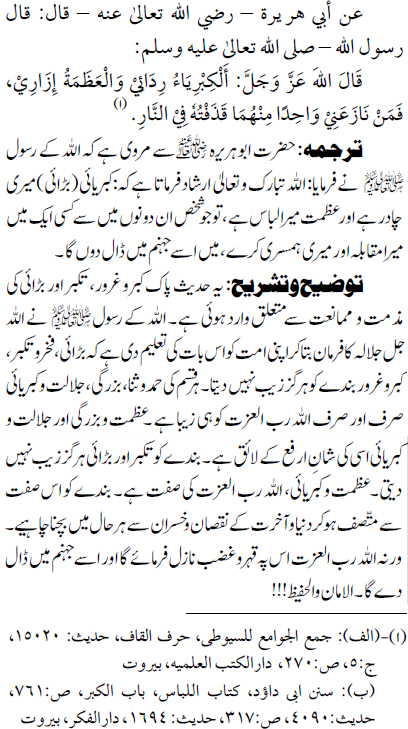
Hadith Qudsi: Takabur Aur Kibr Allah Ki Chadar

Hadith Qudsi: Takabur Aur Kibr Allah Ki Chadar
No Soul Knows What Rewards Allah Has In Store For It
[Allah’s Quran – 32:17] “No soul knows what Allah has in store for it and for the like of it of rewards that shall be viewed with pleasure and with eyes speaking content in requital of what they achieved and attained, fulfilled and completed, perfected and accomplished”
The Prophet (Peace Be Upon Him) has said :
[Hadith – Muslim, Book #040, Hadith #6783] “Sahl b. Sa’d as-Sa’idi reported: I was in the company of Allah’s Messenger (may peace be upon him) that he gave a description of Paradise and then Allah’s Apostle (may peace be upon him) concluded with these words: There would be bounties which the eye has not seen and the ear has not heard and no human heart has ever perceived them. He then recited this verse:” They forsake (their) beds, calling upon their Lord in fear and in hope, and spend out of what We have given them. So no soul knows what refreshment of the eyes is hidden for them: a reward for what they did”
Hadith Qudsi: Allah Rahman, Raheem Aur Ata Karnay Wala

Hadith Qudsi: Allah Rahman, Raheem Aur Ata Karnay Wala
What Holy Quran Says About Associating Allah In Worship
And how should I fear those whom you associate in worship with Allah (though they can neither benefit nor harm), while you fear not that you have joined in worship with Allah things for which He has not sent down to you any authority. (So) which of the two parties has more right to be in security? If you but know.” [6:81]
They (Jews and Christians) took their rabbis and their monks to be their lords besides Allah (by obeying them in things which they made lawful or unlawful according to their own desires without being ordered by Allah), and (they also took as their Lord) Messiah, son of Maryam (Mary), while they (Jews and Christians) were commanded [in the Tauraat (Torah) and the Injeel (Gospel)) to worship none but One Ilaah (God – Allah) Laa ilaaha illa Huwa (none has the right to be worshipped but He). Praise and glory be to Him, (far above is He) from having the partners they associate (with Him).” [9:31]
And they worship besides Allah things that hurt them not, nor profit them, and they say: “These are our intercessors with Allah.” Say: “Do you inform Allah of what He knows not in the heavens and on the earth?” Glorified and Exalted be He above all that which they associate as partners with Him! [10:18]
Say (O Muhammad): “I am only a man like you. It has been inspired to me that your Ilah (God) is One Ilah (God i.e. Allah). So whoever hopes for the Meeting with his Lord, let him work righteousness and associate none as a partner in the worship of his Lord.” [18:110]
And (remember) when We showed Ibrahim (Abraham) the site of the (Sacred) House (the Ka’bah at Makkah) (saying): “Associate not anything (in worship) with Me, [La ilaha ill-Allah (none has the right to be worshipped but Allah Islamic Monotheism], and sanctify My House for those who circumambulate it, and those who stand up for prayer, and those who bow (submit themselves with humility and obedience to Allah), and make prostration (in prayer, etc.);” [22:26]
And let them not turn you (O Muhammad ) away from (preaching) the Ayat (revelations and verses) of Allah after they have been sent down to you, and invite (men) to (belief in) your Lord [i.e: in the Oneness (Tauhid) of Allah (1) Oneness of the Lordship of Allah; (2) Oneness of the worship of Allah; (3) Oneness of the Names and Qualities of Allah], and be not of the mushrikun (those who associate partners with Allah, e.g. polytheists, pagans, idolaters, those who disbelieve in the Oneness of Allah and deny the Prophethood of Messenger Muhammad). [28:87]
Allah is He Who created you, then provided food for you, then will cause you to die, then (again) He will give you life (on the Day of Resurrection). Is there any of your (socalled) partners (of Allah) that do anything of that? Glory be to Him! And Exalted be He above all that (evil) they associate (with Him). [30:40]
He is Allah than Whom there is La ilaha illa Huwa (none has the right to be worshipped but He) the King, the Holy, the One Free from all defects, the Giver of security, the Watcher over His creatures, the All-Mighty, the Compeller, the Supreme. Glory be to Allah! (High is He) above all that they associate as partners with Him. [59:23]
Hadith Qudsi: Allah Ka Fazal Aur Ihsan


Hadith Qudsi: Allah Ka Fazal Aur Ihsan
Hadith Qudsi: Roza Allah Kay Liye Hai Aur Allah He Ajar Day Ga

Hadith Qudsi: Roza Allah Kay Liye Hai Aur Allah He Ajar Day Ga
There Is No Obedience To Anybody While Disobeying Allah
A general rule of Islam implies that there is no obedience to any creature when it involves disobedience (or sinning) to Allah, the Exalted. Obedience to others other than Allah is only allowed in matters of one’s likes and dislikes. The Messenger of Allah (sallallahu alaihi wa-sallam) said: “He who complies with the command of a master, a leader or a ruler in disobedience and defiance of Allah is an unbeliever and a Mushrik (he who associates partners with Allah). There shall be no obedience to a creature of Allah when it would involve disobeying or displeasing Allah.” [Saheeh Muslim, Book Imarah, p.1469]
He (sallallahu alaihi wa-sallam) also said: “Obedience is only in what is good.” [Saheeh al-Bukharee (Eng. trans. 9/193/259) and Saheeh Muslim (Eng. trans. 3 / 1022/no.4535)
And: “Hearing and obeying is (binding) upon the Muslim in what he likes or dislikes, so long as he is not ordered to sin. If he is ordered with sin, then there is no hearing and no obeying.” [Agreed upon]
Similarly, obedience to parents is only obligatory in matters that are permitted by Allah, the Exalted, and as Allah says: But if they (both) strive with you to make you join in worship with Me others that of which you have no knowledge, then obey them not, but behave with them in the world kindly, and follow the path of him who turns to Me in repentance and in obedience. Then to Me will be your return, and I shall tell you what you used to do. (31:15)
Imam Ibn Katheer (may Allah have mercy upon him) writes in the Tafseer of the above verse: “means, if they try hard to make you follow them in their (false) religion, then do not accept that from them, but do not let that stop you from behaving towards them with respect.”
Allah also said in Soorah Al-Ankabut, “And We have enjoined on man to be good and dutiful to his parents, but if they strive to make you join with Me (in worship) anything (as a partner) of which you have no knowledge, then obey them not. Unto Me is your return, and I shall tell you what you used to do.” (29: 8)
An excellent example of the above (first) verse is found in the narration of Sa’d Ibn Malik, who said: “This verse (31:15) was revealed concerning me. I was a man who honored his mother, but when I became a Muslim, she said: ‘O Sa’d! What is this new thing I see you doing? Leave this religion of yours, or I will not eat or drink until I die, and people will say: ‘Shame on you, for what you have done to me and they will say that you have killed your mother.’ I said, ‘Do not do that, O mother, for I will not give up this religion of mine for anything.’ She stayed without eating for one day and one night, and she became exhausted; then she stayed for another day and night without eating, and she became utterly exhausted. When I saw that, I said: ‘O mother, by Allah, even if you had one hundred souls and they were to depart one by one, I would not give up this religion of mine for anything, so if you want to, eat, and if you want to, do not eat.’ So she ate.” [Mentioned by Ibn Al-Athir in Usd al-Ghabah 2: 216]
Shaikh al-Islam Ibn Taymiyyah said: “Abu Bakr said in his book, Zad-ul-Musafir, ‘Whosoever made his parents angry and brought tears to them is required to go back and make them laugh.’ This indicates that it is necessary to obey parents with regards to permissible things and whatever they command should be avoided, if all this brings their benefit and does not harm their child, including ending travel plans and staying with them if they wished that.’
Hadith Qudsi: Allah Ki Takzeeb Na Karo

Hadith Qudsi: Allah Ki Takzeeb Na Karo