
TAG: Istinja
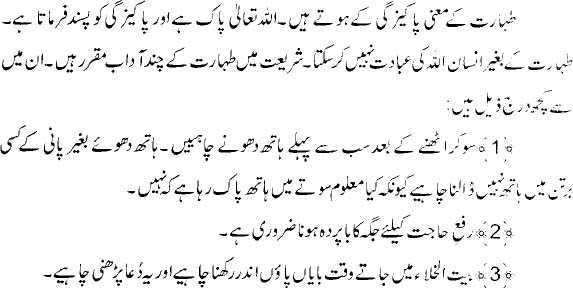
Istinja: Cleaning Private Parts After Urination and Excretion
Allah says in Holy Quran (9:109):”…..therein, where there are men who love to purify themselves. Allah Loves the pure…”
This verse was revealed in which Allah is praising the people of Quba who were accustomed to using both stones and water after calls of nature
Q. What is meant by Istinja?
A. Istinja means the removal of dirt that is left on the body after the call of nature: such as urine, or faeces.
Q. How to perform Istinja after urination?
A. After passing urine, its drops should be dried with clean mud, and then washed with water.
Q. How to perform Istinja after excreting faeces?
A. After discharging faeces, the unclean area should be wiped with three or five pieces of mud. Then wash the body with clean water.
Q. What is the importance of Istinja?
A. Istinja is desirable (Mustahab) if excrement or urine has not smeared the private parts. Istinja is Sunnah (Masnun) if the dirt spreads around, but covers less than, or equal to a ‘Dirham’ in area. But if the dirt covers space of over one ‘Dirham’, it is obligatory (Fard) to perform Istinja.
Q. Which substances may be used for Istinja?
A. Clean mud or pieces of stone can be used for this purpose. ( note: If there are no proper facilities for the disposal of mud and pebble-like, instead only water must be used alternatively use toilet paper before applying water
Q. Which substances are undesirable (Makruh) for performing Istinja?
A. It is undesirable (Makruh) to perform Istinja with: bones dung; horse dung; edibles; coal; pieces of cloth and paper. (toilet paper may be used)
Q. Which hand should be used to perform Istinja?
A. The left hand should be used. It is undesirable (Makruh) to use the right hand.
Q. What things are undesirable (Makruh) in Istinja?
A. It is undesirable to do the Istinja: (I) Facing the Qiblah, or sitting with one’s back in that direction. (2) At a place where parts of the body that must remain covered from others (Satr) are exposed to others.
Q. What things are undesirable (Makruh) while urinating, or passing stool?
A.
- Urinating or passing stool in a position with the Qiblah in front or at the back.
- It is undesirable (Makruh) to pass urine or stool at a place where the ‘Satr’ is exposed to one’s view.
- Urinating in a standing position.
- Urinating or passing stool in a pond, canal, or well.
- Urinating or passing stool at the bank of a canal, pond etc.
- Urinating or passing stool near the wall of a mosque.
- Urinating or passing stool in a graveyard.
- Urinating into a rat’s hole or any other hole in the ground.
- Talking, while urinating or passing stool.
- Aiming the urine, from a lower place towards a higher surface.
- Urinating or passing stool at a public resort or pathway.
- Urinating or passing stool at a place which is meant for Ablution or bath.
The Bath (Ghusl)
The major Uncleanliness (Najaasat-eHukmiyaah i.e. Hadas-e-Akbar and Janabat) can only be removed from the body by washing the entire body (bath) as known as (ghusl).
Three kinds of ghusl:
- Obligatory (Fard)
- Sunnah
- Desirable (Mustahab)
Fard Ghusl (Ghusl has to be done in these circumstances):
- Discharge of semen in any circumstances
- Sexual intercourse
- Menses (Hajdh)
- Blood discharge after childbirth (Nifaas)
In-state of janaabat the following actions are prohibited
- Salaat (Prayers of any type)
- Touching the Holy Quran
- Reciting the Holy Quran
- To enter a Masjid (mosque)
- To make Tawaaf of Ka’bah
Method Of Ghusl:
- Wash hands up to the wrists.
- Clean the private parts also known as Istinja and remove the major Uncleanliness, if any, from the body.
Perform Ablution (Wudu). - Pour some water and rub the whole body. Pour water again over the whole body, three times. Then rinse the mouth and sniff water into the nostrils.
Faraid Of Ghusl:
- Rinsing the mouth.
- Sniffing water into the nostrils.
- Pouring water over the whole body so no single part of the body remained dry including hairs.
Sunnan Of Ghusl:
- Washing both hands up to the wrists.
- Washing the private parts and such areas which are not clean.
- Having the intention (Niyah) to remove the uncleanliness.
- Pouring the water thrice, on the whole body.
It Is Disliked To Perform Istijmaar With Bones Or Manure
Although Allah (SWT) upon the tongue of His Prophet (saas) permitted the use of stones and other pure objects as an alternative to water for purification, He (SWT) forbade the use of manure and bones. Perhaps these two objects are not suited for the purpose of purification, and that is the reason behind the prohibition; or perhaps there is another reason for the prohibition that we do not know about, in which case simple, unquestioning obedience is required from us. Once, when the Prophet (saas) was relieving himself, Abdullah Ibn Masood (RA) was nearby, Abdullah (RA) later related, The Prophet (saas) went to Al-Ghaait ( a place prepared as a toilet) and he ordered me to bring him three stones, but I only found two stones, and though I searched for a third, I couldn’t find one. So I took (a piece) of manure, and I went with what I had to the Prophet (saas) He (Saas) took the two stones and cast away the manure. And he (saas) said
This is Impure. 2 .. Related by Bukhaaree (156), Ahmad (3677)
In the hitherto related Hadeeth of Abu Hurairah (RA), the Prophet (saas) said to him,
Search out for stones. I will purify myself with them and do not come to me with bones or manure.
Abu Hurairah (RA) later related, Then I said, What is the problem with bones and manure? He (saas) said,
They are the food of Jinns. (Related by Bukhaaree In Al-Manaaqib (3860)
A delegation of Jinns from Naseebeen – and good indeed are those Jinns – came to me and asked me for provision, and so I invoked Allah (SWT) for them – that they should never pass by any bones or manure except that they should find food upon them. This narration makes clear the reason why it is forbidden to purify oneself with either bones or manure.
Related Issue: Bases on the above-mentioned ruling for the food of Jinn, it is also forbidden to perform Al-Istinjaa or AL-Istijmaar with the food of human beings. Similarly, it is forbidden to perform Al-Istinjaa or Al-Istijmaar with honored paper, such as the paper on which religious knowledge is written, for that paper is likely to have written on it verses of the Quran or Allah’s beautiful Names and Attributes. And an even worst offense is to use the Quran itself.
Istinja

Sunnahs Of Prophet Muhammad [PBUH]
Sunnahs of Prophet Muhammad [PBUH]
A Quick Refresher – Sunnahs of Our Beloved Prophet Muhammad [PBUH]
Sunnahs of Eating:
- Sit and eat on the floor.
- Spread out a cloth on the floor first before eating.
- Wash both hands up to the wrists.
- Recite ‘Bismillah wa’la barakatillah’ aloud.
- Eat with the right hand.
- Eat from the side that is in front of you.
- If a morsel of food falls down, pick it up, clean it and eat it.
- Do not lean and eat.
- Do not find fault with the food.
- Remove your shoes before eating.
- When eating, sit with either both knees on the ground or one knee raised or both knees raised.
- Clean the plate and other utensils thoroughly after eating.
- By doing this, the utensils make dua for one’s forgiveness.
- Recite dua after eating.
- First, remove the food then get up.
- After meals wash both hands.
- Thereafter gargle the mouth.
- Whilst eating one should not remain completely silent.
- Eat with three fingers if possible.
- One should not eat very hot food.
- Do not blow on the food.
- After eating one should lick his fingers.
Sunnahs of drinking:
- A Muslim should drink with the right hand. Shaytaan Drinks with the left hand.
- Sit and drink.
- Recite ‘Bismillah’ before drinking.
- After drinking say ‘ Alhamdullilah’.
- Drink in 3 breaths removing the utensil from the mouth after each sip.
- Do not drink directly from the jug or bottle. One should pour the contents into a glass first and then drink.