
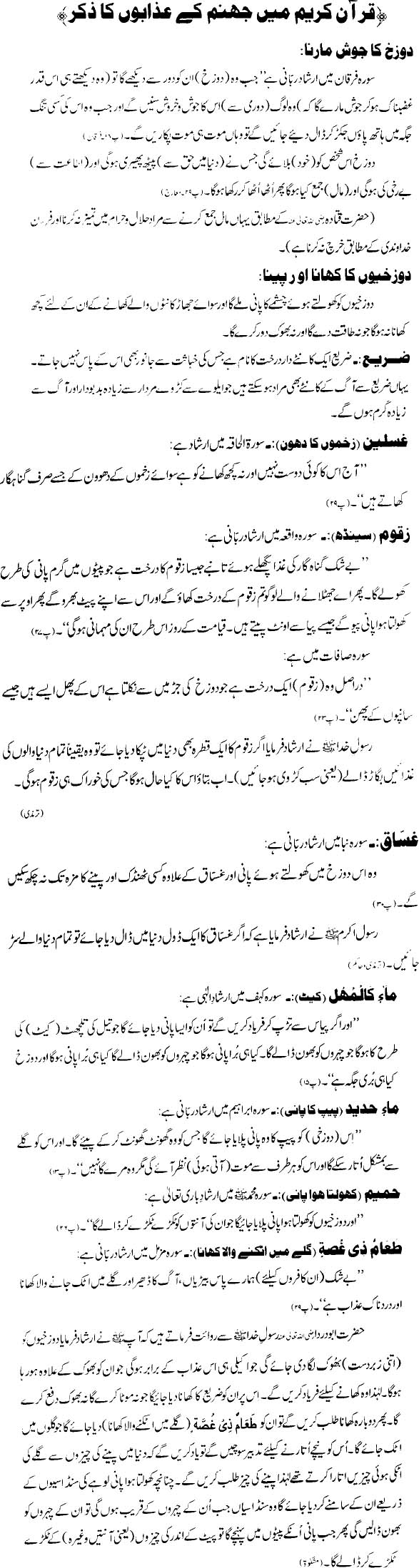
Quran Kareem Mein Jahannam Kay Azabon Ka Zikr
TAG: Quran
True Guidance: Only From The Quran
“This is a communication to be transmitted to mankind so that they may be warned by it and so that they will know that He is One God and so that people of intelligence will pay heed.” [14: 52]
“It is a Book We have sent down to you, full of blessing, so let people of intelligence ponder its Signs and take heed.” [38:29]
“Am I to desire someone other than Allah as a judge when it is He Who has sent down the Book to you clarifying everything?” Those We have given the Book know it has been sent down from your Lord with truth, so on no account be among the doubters.” [6: 114]
“In this way, we have sent it down as Clear Signs. Allah guides anyone He wills.” [22: 16]
“And We have indeed made the Qur’an easy to understand and remember: then is there any that will receive admonition?” [54:17]
As is seen in the above-quoted verses, Allah informs us that only the people of intelligence, who have the faith described in the Qur’an, can take heed. And remember that the Qur’an is made easy for us to reflect and take advice.
The Ummahs Humiliation A Manifestation Of Allah’s Punishment
“Then when there came the first of the two promises (of Divine Punishment), We sent against you servants unto Us who were most powerful in warfare. Then they penetrated the homes. Indeed, it was a decree executed.”
(Surah Bani Israaeel, aayat 5)
“When the final promise (of Divine Punishment) came, (it came) so that they could (the kuffaar) disfigure your faces and enter the Musjid (i.e. Musjidul Aqsa) as they had entered the first time, and so that they could utterly destroy whatever they overran.”(Surah Bani Israaeel, aayat 8)
In these Quranic verses, Allah Ta’ala refers to His punishment which He had inflicted on the Muslims of former times. The specific community referred to in these verses is Bani Israel. Two occasions of punishment are mentioned here. On both occasions, Allah Ta’ala used the kuffaar to overwhelm, punish, and humiliate the Muslims. The punishments had taken the form of kuffaar atrocities-pillage, plunder, killing, and humiliating the Muslims, as well as the desecration of Musjidul Aqsa
The ayat specifically mentions the destruction that the kuffaar wrought to the Masjid Aqsa. Allah Ta’ala allowed the kuffaar to invade the Masjid Aqsa —to defile and violate its sanctity. The then Muslims were just as helpless as present-day Muslims. They had to suffer the punishment and humiliation without being able to offer any response and unable to defend either themselves or their holy places.
Allah’s Servants
It is significant that in the ayah, the Quran refers to the kuffaar who had defiled and destroyed Musjidul Aqsa and who had ravaged the Muslims of the time, as `servants unto Us’. This style of expression conveys that the kuffaar were appointed by Allah Ta’ala to inflict the punishment, atrocities, and humiliation on the Muslims who are supposed to be the true and obedient slaves and servants of Allah Ta’ala.
This style of expression implies that the domination of the kuffaar over Muslims is in fact a manifestation of Allah’s punishment. Throughout the world’s history, this has always been the case. When the Muslim Ummah had transgressed all bounds of disobedience and had firmly resolved to adopt transgression, sin, and kuffaar lifestyle as their way of life, then Allah Ta’ala unleashed His punishment, which sometimes came in the form of natural disasters and sometimes in the form of kuffaar brutality and domination.
The Cause
In this age, too, Muslims have degenerated to the lowest level of fisq and fujoor (transgression and immorality). The Sunnah of Rasulullah (sallallahu alayhi wasallam) has been jettisoned right out of our lives, and the lifestyle and concepts of the kuffaar have become the complete culture and code of life of Muslims. It is for this reason that Allah Ta’ala has manifested His punishment on us in the form of kuffaar atrocities and domination over the Ummah. He has made us the slaves of the very kuffaar whom we have appointed as our intellectual masters, whose lifestyle Muslims are emulating in its entirety. Therefore, He has once again sent His kuffaar `ibaad’ (servants) to punish and disgrace us, as he had done with Bani Israel when they had reached the point of no return in their transgression.
Thus, the cause of our degradation, humiliation, and of the calamities which are befalling the Ummah, is not America or the Shaitan. Rather, these events via the agency of the kuffaar are Allah’s punishment. It is He Who has chosen America to punish and humiliate the Muslims. It is He Who has chosen the Yahood to inflict such terrible acts of brutality on Muslims.
Meanings, Total Ayahs And Total Rukus Of 114 Surahs Of Quran
| Serial # | Surah Name | Meaning | Total Ayahs | Total Rukus |
|---|---|---|---|---|
| 1 | Fatehah | The Opening | 7 | 1 |
| 2 | Baqarah | The Cow | 286 | 40 |
| 3 | Aal-e-Imran | The Family of Imran | 200 | 20 |
| 4 | Nisaa | The Women | 176 | 24 |
| 5 | Maidah | The Table spread with foods | 120 | 16 |
| 6 | Al-Anaam | The Cattle | 165 | 20 |
| 7 | Al-Araaf | The wall with Elevations | 206 | 24 |
| 8 | Al-Anfaal | The Spoils of War | 75 | 10 |
| 9 | Tawbah | The Repentance | 129 | 16 |
| 10 | Yunus | The Prophet [Jonah] | 109 | 11 |
| 11 | Hud | The Prophet Hood | 123 | 10 |
| 12 | Yusouf | The Prophet [Joseph] | 111 | 12 |
| 13 | Ar-Ra'ad | The Thunder | 43 | 6 |
| 14 | Ibrahim | The Prophet [Abraham] | 52 | 7 |
| 15 | Hijr | The Rocky Tract | 99 | 6 |
| 16 | Nahl | The Bee | 128 | 16 |
| 17 | Israa | The Journey by Night | 111 | 12 |
| 18 | Al-Kahf | The Cave | 110 | 12 |
| 19 | Maryam | Mary (Mother of Jesus) | 98 | 6 |
| 20 | Taha | One of the Names of Prophet Muhammad | 135 | 8 |
| 21 | Al-Anbiya | The Prophets | 112 | 7 |
| 22 | Al-Hajj | The Pilgrimage | 78 | 10 |
| 23 | Al-Muminun | The Believers | 118 | 6 |
| 24 | Al-Nur | The Light | 64 | 9 |
| 25 | Al-Farqan | The Criterion | 77 | 6 |
| 26 | Ash-Shu'ara | The Poets | 227 | 11 |
| 27 | Al-Naml | The Ant | 93 | 7 |
| 28 | Al-Qasas | The Narration | 88 | 9 |
| 29 | Al-Ankabut | The Spider | 69 | 7 |
| 30 | Al-Rum | The Romans | 60 | 6 |
| 31 | Luqman | Luqman (A wise Man) | 34 | 4 |
| 32 | As-Sajdah | The Prostration | 30 | 3 |
| 33 | Al-Ahzab | The Confederates | 73 | 9 |
| 34 | Al-Saba | Sheba (The Queen) | 54 | 6 |
| 35 | Al-Fatir | The Originator of Creation | 45 | 5 |
| 36 | Ya'sin | One of the Names of Prophet Muhammad | 83 | 5 |
| 37 | As-Saffat | Those Ranged in Ranks | 182 | 5 |
| 38 | Suad | Arabic Alphabet | 88 | 5 |
| 39 | Az-Zamar | The Groups | 75 | 8 |
| 40 | Al-Mumin | The Forgiver/The Believer | 85 | 9 |
| 41 | Hamim Sajdah | In Detail | 54 | 6 |
| 42 | Ash-Shura | The Consultations | 53 | 5 |
| 43 | Al-Aukhruf | The Gold Adornment | 89 | 7 |
| 44 | Al-Dukhan | The Smoke | 59 | 3 |
| 45 | Al-Jathiyah | The Kneeling | 37 | 4 |
| 46 | Al-Ahqaf | The Curved-Sand Hills | 35 | 4 |
| 47 | Muhammad | The Prophet Muhammad | 38 | 4 |
| 48 | Al-Fath | The Victory | 29 | 4 |
| 49 | Al-Hujurat | The Dwellings | 18 | 2 |
| 50 | Q'af | Arabic Alphabet | 45 | 3 |
| 51 | Al-Dhariyat | The wind that Scatters | 60 | 3 |
| 52 | Al-Tur | The Name of Mountain | 49 | 2 |
| 53 | Al-Najm | The Star | 62 | 3 |
| 54 | Al-Qamr | The Moon | 55 | 3 |
| 55 | Ar-Rahman | The Most Gracious | 78 | 3 |
| 56 | Al-Waqiah | The Event | 96 | 3 |
| 57 | Al-Hadid | Iron | 29 | 4 |
| 58 | Al-Mujadila | The Disputation | 22 | 3 |
| 59 | Al-Hashr | The Gathering | 24 | 3 |
| 60 | Al-Mumtahana | The Woman to be Examined | 13 | 2 |
| 61 | As-Saff | The Row or The Rank | 14 | 2 |
| 62 | Al-Jumah | Friday | 11 | 2 |
| 63 | Al-Munafiqun | The Hypocrites | 11 | 2 |
| 64 | Al-Taghabun | Mutual Loss or Gain | 18 | 2 |
| 65 | Al-Talaq | The Divorce | 12 | 2 |
| 66 | Al-Tahrim | The Prohibition | 12 | 2 |
| 67 | Al-Mulk | Dominion | 30 | 2 |
| 68 | Al-Qalam | The Pen | 52 | 2 |
| 69 | Al-Haqqah | The Inevitable | 52 | 2 |
| 70 | Al-Maarij | The Way of Ascent | 44 | 2 |
| 71 | Noah | The Prophet Noah | 28 | 2 |
| 72 | Al-J'nn | Genie | 28 | 2 |
| 73 | Al-Muzammil | The One wrapped in Garment | 20 | 2 |
| 74 | Al-Mudashir | The One Enveloped | 56 | 2 |
| 75 | Al-Qiyamah | The Resurrection | 40 | 2 |
| 76 | Al-Dahr | The Time | 31 | 2 |
| 77 | Al-Mursalat | Those Sent Forth | 50 | 2 |
| 78 | Al-Naba | The Great News | 40 | 2 |
| 79 | Al-Naziat | Those Who Pull Out | 46 | 2 |
| 80 | Abasa | The Frowned | 42 | 1 |
| 81 | Al-Takwir | Wound Round and Lost its Light | 29 | 1 |
| 82 | Al-Infitar | The Cleaving | 19 | 1 |
| 83 | Al-Mutaffafin | Those Who Deal in Fraud | 36 | 1 |
| 84 | Al-Inshiqaq | The Splitting Asunder | 25 | 1 |
| 85 | Al-Bhruj | The Big Stars | 22 | 1 |
| 86 | Al-Tariq | The Night-Comer | 17 | 1 |
| 87 | Al-A'la | The Most High | 19 | 1 |
| 88 | Al-Ghashiya | The Overwhelming | 26 | 1 |
| 89 | Al-Fajr | The Break of the Day/The Dawn | 30 | 1 |
| 90 | Al-Balad | The City | 20 | 1 |
| 91 | Ash-Shams | The Sun | 15 | 1 |
| 92 | Al-Lail | The Night | 21 | 1 |
| 93 | Al-Duha | The Forenoon after Sunrise | 11 | 1 |
| 94 | Al-Inshira | The Opening Forth | 8 | 1 |
| 95 | Al-T'in | The Fig | 8 | 1 |
| 96 | Al-Alaq | The Clot | 19 | 1 |
| 97 | Al-Qadr | The Night of Decree | 5 | 1 |
| 98 | Al-Beyinnah | The Clear Evidence | 8 | 1 |
| 99 | Al-Zilzal | The Earthquake | 8 | 1 |
| 100 | Al-Aadiyat | Those Who Runs | 11 | 1 |
| 101 | Al-Qariah | The Striking Hour | 11 | 1 |
| 102 | Al-Takatur | The Pilling up of Emulous Desire | 8 | 1 |
| 103 | Al-Asr | The Time | 3 | 1 |
| 104 | Al-Humazah | The Slanderer | 9 | 1 |
| 105 | Al-Fil | The Elephant | 5 | 1 |
| 106 | Al-Qureysh | A Famous Arab Tribe | 4 | 1 |
| 107 | Alma'un | The Small Kindnesses | 7 | 1 |
| 108 | Al-Kauthar | A River in Paradise | 3 | 1 |
| 109 | Al-Kafirun | The Disbelievers | 6 | 1 |
| 110 | Al-Nasr | The Help | 3 | 1 |
| 111 | Al-Lahab | The Palm Rope | 5 | 1 |
| 112 | Al-Ikhlas | The Purity | 3 | 1 |
| 113 | Al-Falaq | The Day Break | 5 | 1 |
| 114 | Al-Nas | The People | 6 | 1 |
| Total | 6228 | 557 |
Wise Sayings From Quran
1) Say, “O My servants who have transgressed against themselves [by sinning], do not despair of the mercy of Allah. Indeed, Allah forgives all sins. Indeed, it is He who is the Forgiving, the Merciful. [Az-Zumar 39-53]
2) Wealth and children are [but] adornment (attraction) of the worldly life. But the enduring (everlasting) good deeds are better to your Lord for reward and better for [one’s] hope.[Al-Kahf 18:46]
3) Repel [evil] by that [deed] which is better; and thereupon, the one whom between you and him is enmity [will become] as though he was a devoted friend. [Fussilat 41:34]
4) And peace will be upon he who follows the guidance. [Ta-Ha 20:47]
5) The believers are only those who, when Allah is mentioned, their hearts become fearful, and when His verses are recited to them, it increases them in faith; and upon their Lord they rely. [Al-Anfal 8:2-4]
6) That you not transgress (deceit) within the balance. And establish weight in justice and do not make deficient the balance. [Ar-Rahman 55:8-9] (While selling, man should weigh things honestly)
7) Whom Allah leaves astray, you will never find for them protectors besides Him, and We will gather them on the Day of Resurrection [fallen] on their faces – blind, dumb, and deaf. Their refuge is Hell; every time it subsides We increase them in blazing fire. [Al-Isra 17:97]
8) And whoever turns away from My remembrance – indeed, he will have a depressed [i.e., difficult] life, and We will gather [i.e., raise] him on the Day of Resurrection blind.” He will say, “My Lord, why have you raised me blind while I was [once] seeing?” [Allah] will say, “Thus did Our signs come to you, and you forgot [i.e., disregarded] them; and thus will you this Day be forgotten” [Ta-Ha 20:124-126]
9) And when it is said to them, “Follow what Allah has revealed,” they say, “Rather, we will follow that upon which we found our fathers.” Even if Satan was inviting them to the punishment of the Blaze? [Luqman 31:21]
10) And Allah invites to the Home of Peace [i.e., Paradise] and guides whom He wills to a straight path. [Yunus 10:25]
11) They [think to] deceive Allah and those who believe, but they deceive not except themselves and perceive [it] not. [Al-Baqarah 2:9]
12) O mankind, indeed the promise of Allah is true, So let not the worldly life delude (deceive) you, and let not the chief deceiver [i.e., Satan] deceive you about Allah. [Fatir 35:5]
13) Indeed, As-Salat (prayer) has been enjoined upon the believers at specified times. [Quran Chapter An-Nisa 4:103]
14) Indeed, the Day of Judgment is an appointed time (fixed time). [Quran An-Naba 78:17]
Quran Mein Moat Ka Zikr

Quran Mein Moat Ka Zikr
Happy Ramadan
Many people often don’t get too close to religion. This is because they feel that understanding religion and then following it is very difficult. Therefore, without thinking much about right and wrong, people keep doing things they like. Many times prejudice too keeps a person away from religion.
The teacher of humanity and life among the major religions is Islam. Today we will tell you some interesting secrets of this religion that you have never heard of. This is because they feel that understanding religion and then following it is very difficult. Therefore, without thinking much about right and wrong, people keep doing things they like. Many times prejudice too keeps a person away from religion.
Who celebrates Ramadan?
More than 1 billion Muslims worldwide celebrate Ramadan, including more than 6 million in the United States. Indonesia has the largest Muslim population in the world, with Pakistan, Bangladesh, India and Turkey following. Islam is the fastest-growing religion in America.
When is Ramadan?
Ramadan starts at the beginning of the ninth month of the Islamic calendar. Because Islam observes a lunar calendar, the official beginning occurs at different times around the globe, based on when the crescent moon is first seen. The lunar calendar is about 11 days shorter than the solar calendar.
What is the derivation of “Ramadan”?
Ramadan is derived from the Arabic word ar-ramad, meaning “parched thirst,” and is also the name of the ninth month of the lunar calendar.
How did Ramadan begin?
In approximately 610 A.D., a caravan trader named Muhammad (PBUH) began wandering the desert near Mecca (in today’s Saudi Arabia). The angel Gabriel appeared to him and told him he had been chosen to receive the world of Allah. In the days that followed, Muhammad began speaking and transcribing the words to the Quran (also spelled “Koran”), the sacred book of Islam.
Muslims consider the Quran to be God’s literal speech, recorded in the Arabic language, and transmitted through humanity via Muhammad, who is considered the last of a chain of prophets that included Adam, Abraham, Moses, David, and Jesus.
How is Ramadan celebrated?
Ramadan is a month of heightened devotion, a time when the doors of heaven are kept open, the doors of hell are closed, and Satan is kept in chains. Muslims go through a period of intense reflection and devotion, seeking guidance and forgiveness.
Muslims practice sawm, or fasting, during the entire month. This means they may eat or drink nothing, including water, while the sun shines. Married adults also refrain from marital relations during the hours of fasting (i.e. the daylight hours).
Other duties include five daily prayers and the recitation of the Taraweeh prayer, or Night prayer. At mosques during Ramadan, about one-thirtieth of the Quran is recited in prayers called tarawih. By the end of Ramadan, the entire Quran has been recited.
Why do Muslims fast during Ramadan?
Fasting is one of the Five Pillars (duties) of Islam. The Quran says that the main reason behind fasting is to attain taqwa, or God-consciousness. While they are hungry and thirsty, Muslims are reminded of the suffering of the poor. Fasting is also an opportunity to practice self-control and to cleanse the body and mind. In the Muslim world, most restaurants are closed during the daylight hours during Ramadan. Families get up early for suhoor, a meal eaten before the sun rises. After the sun sets, the fast is broken with a meal known as iftar which usually includes dates, fresh fruits, appetizers, beverages and dinner.
All Muslims partake in the customs and celebration of Ramadan, starting at approximately age 12. Exceptions include men and women who are too old to fast, those who are too ill, women in the advanced stages
of pregnancy, and women who are menstruating.
What does the Quran say about Ramadan?
“The month of Ramadan is the one in which the Quran was sent down, a guidance for mankind, clear proofs for the guidance, the Criterion; so whoever among you witnesses this month, let him fast it.” (Surah al-Baqarah 2:185)
The hadith, a collection of the sayings of Muhammad, recommends the following:
* Study the Quran.
* Come together for this purpose.
* Check your memory of the Quran.
* Increase your recitation of the Quran.
How and when does Ramadan end?
Ramadan ends with the festival of Eid al-Fitr. The “Festival of Breaking the Fast,” Eid al-Fitr, is one of the two most important Islamic celebrations (the other occurs after the Hajj or pilgrimage to Mecca). At Eid al-Fitr people dress in their finest clothes, adorn their homes with lights and decorations, give treats to children, and enjoy visits with friends and family. At the end of Ramadan, Muslims give Zakat al Fitr, a monetary contribution to the poor or their mosques.
I Discovered The Right Religion In Islam
HUDA, Nadia, and Selvi—all converts to Islam—stood outside the Taipei Grand Mosque in Taiwan after a noon prayer service and said their faith had given them strength. A list of questions brought Huda to the Taipei Grand Mosque: “Why can’t they eat pork? Why must women cover up? And why, if men can take four wives, can’t women take four husbands?”
After enrolling in a six-week course on the fundamentals of Islam, she found her answers, and she found religion. “When I first heard about the course, I told myself, ‘This is your time to learn something new.’ I discovered how to live according to the Qur’an, and now I feel very peaceful,” she said.
While stories of suicide attacks and beheading permeate news coverage from Afghanistan and the Middle East, Taipei Grand Mosque Imam Ma Shiao-chi said the number of people visiting the mosque with questions about Islam had increased.
“The news always highlights the bad things. About 90 percent of the news is negative. They hear stories about people getting their heads cut off and think Islam is a bad religion. They know very few things about Islam. They want to know what makes people do these things,” he said.
Their reasons for converting to Islam vary, but these women are finding freedom in Islam.
He said most of those going to the mosque are women. Whether they were born into a non-practicing Muslim family, converted for marriage, or, like Huda, are simply curious to learn more about the religion, the women Ma meets want to better understand the role of women in Islam. Perhaps they have no intentions of converting, Ma said, but at least they take the time to dispel a few stereotypes about the religion.
Some, however, do convert. As a teenager, Sana researched various religions and recalls visiting several temples, but it was Islam that appealed most to her. “So many things led me to feel Islam was the right religion. Even, when I was a child, I never liked to eat pork,” she said.
After living in Pakistan with her husband and children for eight years, Sana said she is now re-adjusting to being part of a minority religion in Taiwan. Taiwan has an estimated 130,000 Muslims, less than half of whom are Chinese Muslims.
“I am Chinese, and I am Muslim,” said Sana, giving the example of wearing a white headscarf, a color often associated with death in Taiwan.
Sana and Huda describe wearing the hijab as an honor and affirmation of their faith. They agreed, however, that while its purpose is to prevent unwanted attention to their bodies, it in fact often draws more attention. This they said is part of learning to live in a non-Muslim society.
Likewise, Huda, who works in an international trading company, was originally told she could not wear her hijab to work, as it might make clients uncomfortable. “Eventually my colleagues and boss accepted it. It took time, but they know being Muslim is an important part of my life,” she said.
While he criticized the unfair portrayal of Islam in the media, Ma said Muslim practitioners in Taiwan experience little harassment from the public. One reason, he said, might have to do with the small number of followers. “We are very few, so we are not really a risk to them,” he said.
The majority of Chinese practicing Islam are second and third-generation Muslims, whose families came to Taiwan with the Chinese Nationalist Party (KMT) in 1949. As years passed, people started to relax their religious compliance, Ma said.
“A lot of Muslims in Taiwan were born Muslims, but not all of them pray every day. But Islam is a lifestyle. You need to do the Muslim practices [the Five Pillars of Islam] or else it is easy to lose the religion,” he said.
Nadia was born into a non-practicing Chinese-Muslim household. Following in her sister’s footsteps, she made the transition to a more pious observance during college. As she learned more about the religion, she began to dress more conservatively, covering all but her face and hands. “It was just an outfit on the outside, but it changed my life on the inside. I felt more confident,” she said.
In addition to Muslims rediscovering their lost faith, Ma said most women embracing Islam in Taiwan do so for marriage. Of the 20 new converts last year, 12 were for marriage, he said.
According to the Qur’an, a Muslim man can marry a woman from a monotheistic religion (Christianity, Islam, and Judaism), but he is prohibited from marrying a woman from a polytheistic religion (Buddhism, Taoism, Hinduism, etc.).
Marriage is how Aisha entered Islam 20 years ago. “In the beginning, it was just for marriage. I could accept that there is only one god and not eat pork. I couldn’t wear the hijab,” she said. A decade later she started reading the Qur’an, attending classes, and wearing the headscarf, and feels her relationship with her husband is better for it. “Now we have the same way of looking at things. I can communicate better with my husband,” she said.
Each of the women said Islam places a large emphasis on respect and equality for women. One of the most debated gender issues in the Qur’an is the tradition that allows Muslim men to take four wives. – The News
By Diana Freundl
Khatma Bil Khair: Quran Karim Say Taluq

Khatma Bil Khair: Quran Karim Say Taluq
Hazrat Ibn e Umar RA Say Sawal: Namaz e Qasar Quran Mein Nahi

Hazrat Ibn e Umar RA Say Sawal: Namaz e Qasar Quran Mein Nahi