
TAG: Quran
Tilawat-e-Quran Kay Ahkam

Muslim Parenting Guide: How to Raise Children in Islam
Providing children with Islamic education and raising them up as good practicing Muslims are essential duties of parenthood.
Rightfully fulfilling these duties will lead to the Pleasure of Allah and good for the parents and the child in this life and the Hereafter.
However, ignoring these duties would lead to the destruction of the child’s Hereafter, and the Wrath of Allah will befall the parents for not protecting their child from the traps of Shaytan and allowing him to choose the path of destruction.
Allah’s Messenger (peace and blessings be upon him) said: “Each of you is a shepherd and each of you is responsible for his flock. The leader is a shepherd and is responsible for his flock,
a man is the shepherd of his family and is responsible for his flock;
a woman is the shepherd in the house of her husband and is responsible for her flock,
the servant is the shepherd of his master’s wealth and is responsible for it.
Each of you is a shepherd and is responsible for his flock.”
[Sahih al-Bukhari and Sahih Muslim]
Allah says in the Quran: “O you who believe! Save yourselves and your family from a fire whose Fuel is men and stones.” [Noble Quran 66:6]
One way to protect your children from the Fire is to let them memorize the Words of Allah.
The Prophet (peace and blessings be upon him) said: “If the Quran is gathered in a body (i.e. a person), Allah will not burn him with the Fire.” [al-Baihaqi, Authenticated by Sheikh al-Albani]
This is because the child from an early age will be protected from the temptations of the world and whispers of the Shaytan, he will live and grow up among the gathering of Dhikr (remembrance of Allah) where tranquility and the mercy of Allah descends, and as a result, Allah will preserve his Fitrah (natural inclination of Islamic Monotheism)
The Prophet (peace and blessings be upon him) said: “No people gather in a house of the houses of Allah (i.e. Masjid) reciting the Book of Allah and studying it among themselves, except that the tranquility descends upon them, and Allah mentions them to those who are with Him (the lofty gathering of Angels).” [Sahih Muslim]
Your child will be given a position in Paradise according to the number of verses he memorizes from the Book of Allah, it will be said to him on the Day of Judgment as the Prophet (peace and blessings be upon him) said:
“‘Read, ascend and recite with slow, rhythmic chanting just as you used to recite in the worldly life. For verily, your position (in Paradise) will be at the place of the last verse that you recite.” [Abu Dawud and at-Tirmidhi]
Every time your child goes to the Masjid to learn the Quran he will have the reward of a perfect Hajj.
The Prophet (peace and blessings be upon him) said: “Whoever goes to the Masjid in the morning having no intention except to learn something good or teach it he will have the reward like the person who performs Hajj.”
[At-Tabari. Authenticated by Sheikh al-Albani]
The Prophet (peace and blessings be upon him) said to Abu Dharr, “O Abu Dharr! That you set out in the morning and learn one verse from the Book of Allah is better for you than if you prayed one hundred Rakahs (units of prayer).” [Ibn Majah]
The Quran will intercede for your child on the Day of Judgment, Allah’s Messenger (peace and blessings be upon him) said: “Recite the Quran for verily it will come on the Day of Judgment as an intercessor for those who recited it.”
[Sahih Muslim]
Your child will be given to wear garments and a crown of honor on the Day of Judgment.
The Prophet (peace and blessings be upon him) said: “The Quran will come on the Day of Judgment and say, ‘Oh Lord! Adorn him.’ So the person will be made to wear the crown of honor. Then it (the Quran) will say, ‘Oh Lord! Increase him.’ So the person will be made to wear the garment of honor. Then it will say, ‘Oh Lord! Be pleased with him.’ So Allah will be pleased with him. Then it will be said, ‘Recite and ascend.’ And the person will receive an extra good deeds for every verse (that he recites of the Quran.)” [Sahih at-Tirmidhi]
The Prophet (peace and blessings be upon him) said: “Whoever recites the Quran, learns it, and acts upon it will be given a crown of light to wear on the Day of Judgment and its light will be like the light of the sun.” [Sahih al-Hakim]
So, why not encourage our children to memorize the Quran and make them one of the best individuals of this Ummah.
Allah’s Messenger (peace and blessings be upon him) said: “The best of you are those who learn the Quran and teach it.” [Sahih al-Bukhari]
Allah, the Exalted, has also promised abundant rewards for those parents who guide their children to memorize the Quran.
The Prophet (peace and blessings be upon him) said: “Whoever recites the Quran, learns it, and acts according to it will be given a crown of light to wear on the Day of Judgment whose light will be like the sun. His parents will be clothed in two garments that did not exist in this worldly life. So they will say, ‘What has caused us to be clothed (in these garments)?’ It will be said, ‘Your child taking hold of (i.e. memorizing) the Quran has caused this.'” [Al-Hakim graded it authentic]
When the parents leave a righteous child behind them, the child will be a source of reward and blessing for them after their death, for Allah’s Messenger (peace and blessings be upon him) said: “When a man dies, all his good deeds come to an end, except for three cases;
the charity of continuous blessings,
beneficial knowledge that he leaves behind,
and a righteous child who prays for him.” [Sahih Muslim]
The parents will also receive an equal amount of reward that the child receives by memorizing or reciting the Quran, for the parents guide him to this good act and instill in his heart the love for Islam, and the love for the Book of Allah.
The Prophet (peace and blessings be upon him) said: “Whoever guides to something good is like the one who does it.” [Sahih Muslim]
“Whoever invites guidance will receive the reward like the rewards of those who follow him and that will not diminish anything from their rewards…” [Sahih Muslim]
The parents should also send those children who are intelligent and bright to learn the Quran and Islamic education.
It should not be that only those children who when are unsuccessful in worldly studies are sent to Madrasas for religious studies.
The parents should realize the importance of Islamic education for their children and raise well-educated Muslims who would in the future work for the Cause of Islam.
The Prophet (peace and blessings be upon him) said: “The example of guidance and knowledge with which, Allah has sent me is like abundant rain falling on the earth, some of which was fertile soil, absorbed rain water and brought forth vegetation and grass in abundance. (And) another portion of it was hard and held the rainwater and Allah benefited the people with it and they utilized it for drinking, making their animals drink from it, and for irrigation of the land for cultivation. (And) a portion of it was barren which could neither hold the water nor bring forth vegetation (then that land gave no benefits).
The first is the example of the person who comprehends Allah’s religion and gets the benefit (from the knowledge), which Allah has revealed through me (the Prophet) and learns and then teaches others.
The last example is that of a person who does not care for it and does not take Allah’s guidance revealed through me (He is like that barren land.)” [Sahih al-Bukhari v.1 no.79]
Those parents who give the excuse that their child is weak or does not have a good memory or ‘he is not gifted’, should know that Allah has said in the Quran: “And indeed we have made the Quran easy to remember.” [Noble Quran 54:17]
And the Messenger of Allah (peace and blessings be upon him) said: “Whoever treads on a path in search of Islamic knowledge, Allah will ease the way to Paradise for him. The Angels will lower their wings, pleased with this seeker of knowledge, and everyone in the heavens and on earth will ask forgiveness for the knowledgeable person, even the fish in the deepest of waters will ask for his forgiveness.” [Sahih Abu Dawud, Ibn Majah and at-Tirmidhi (2835)]
It is not mandatory for your child to memorize the complete Quran. If he is not able to memorize the complete Quran then know that only attending daily circle for memorization will suffice for your child for it will accustom him to frequent the places of worship rather than visiting evil gatherings.
Your child will find good companions which will protect him from deviating and adopting evil habits and practices.
Allah says: “And keep yourself patiently with those who call on their Lord, morning and afternoon, seeking His Face and let not your eyes overlook them, desiring the pomp and glitter of the life of the world; and obey not him whose hearts We have made heedless of Our Remembrance, one who follows his own lust and whose affairs (deeds) have been lost.” [Noble Quran 18:28]
- October, 19
- 3650
- Human Rights
- More
The Quran Is Full Of Wisdom
[1:1] In the name of GOD, Most Gracious, Most Merciful
[36:2] And the Quran that is full of wisdom.
The Quran is full of wisdom, and Muhammad taught his followers the same.
[10:1] A.L.R. These (letters) are the proofs of this book of wisdom.
[31:1] A. L. M.
[31:2] These (letters) constitute proofs of this book of wisdom.
[31:3] A beacon and a mercy for the righteous.
[36:1] Y. S. (Yaa Seen)
[36:2] And the Quran that is full of wisdom.
[43:1] H. M.
[43:2] And the enlightening scripture.
[43:3] We have rendered it an Arabic Quran, that you may understand.
[43:4] It is preserved with us in the original master, honorable and full of wisdom.
[44:4] In it (the scripture), every matter of wisdom is clarified.
[3:164] GOD has blessed the believers by raising in their midst a messenger from among them, to recite for them His revelations, and to purify them, and teach them the scripture and wisdom. Before this, they had gone totally astray.
[17:31] You shall not kill your children due to fear of poverty. We provide for them, as well as for you. Killing them is a gross offense.
[17:32] You shall not commit adultery; it is a gross sin and evil behavior.
[17:33] You shall not kill any person – for GOD has made life sacred – except in the course of justice. If one is killed unjustly, then we give his heir authority to enforce justice. Thus, he shall not exceed the limits in avenging the murder; he will be helped.
[17:34] You shall not touch the orphans’ money except for their own good until they reach maturity. You shall fulfill your covenants, for a covenant is a great responsibility.
[17:35] You shall give full measure when you trade, and weigh equitably. This is better and more righteous.
[17:36] You shall not accept any information unless you verify it for yourself. I have given you the hearing, the eyesight, and the brain, and you are responsible for using them.
[17:37] You shall not walk proudly on earth – you cannot bore through the earth, nor can you be as tall as the mountains.
[17:38] All bad behavior is condemned by your Lord.
[17:39] This is some of the wisdom inspired to you by your Lord. You shall not set up another god beside GOD, lest you end up in Gehenna, blamed and defeated.
[33:32] O wives of the prophet, you are not the same as any other women, if you observe righteousness. (You have a greater responsibility.) Therefore, you shall not speak too softly, lest those with the disease in their hearts may get the wrong ideas; you shall speak only righteousness.
[33:33] You shall settle down in your homes, and do not mingle with the people excessively like you used to do in the old days of ignorance. You shall observe the Contact Prayers (Salat), and give the obligatory charity (Zakat), and obey GOD and His messenger. GOD wishes to remove all unholiness from you, O you who live around the Sacred Shrine, and to purify you completely.
[33:34] Remember what is being recited in your homes of GOD’s revelations and the wisdom inherent therein. GOD is Sublime, Cognizant.
[62:2] He is the One who sent to the gentiles a messenger from among them, to recite to them His revelations, purify them, and teach them the scripture and wisdom. Before this, they had gone far astray.
[2:127] As Abraham raised the foundations of the shrine, together with Ismail (they prayed): “Our Lord, accept this from us. You are the Hearer, the Omniscient.
[2:128] “Our Lord, make us submitters to You, and from our descendants let there be a community of submitters to You. Teach us the rites of our religion, and redeem us. You are the Redeemer, Most Merciful.
[2:129] “Our Lord, and raise among them a messenger to recite to them Your revelations, teach them the scripture and wisdom, and purify them. You are the Almighty, Most Wise.”
[2:130] Who would forsake the religion of Abraham, except one who fools his own soul? We have chosen him in this world, and in the Hereafter, he will be with the righteous.
[2:150] Wherever you go, you shall turn your face (during Salat) towards the Sacred Masjid; wherever you might be, you shall turn your faces (during Salat) towards it. Thus, the people will have no argument against you, except the transgressors among them. Do not fear them, and fear Me instead. I will then perfect My blessings upon you, that you may be guided.
[2:151] (Blessings) such as the sending of a messenger from among you to recite our revelations to you, purify you, teach you the scripture and wisdom, and teach you what you never knew.
[2:152] You shall remember Me, that I may remember you, and be thankful to Me; do not be unappreciative.
[2:231] If you divorce the women, once they fulfill their interim (three menstruations), you shall allow them to live in the same home amicably, or let them leave amicably. Do not force them to stay against their will, as revenge. Anyone who does this wrongs his own soul. Do not take GOD’s revelations in vain. Remember GOD’s blessings upon you, and that He sent down to you the scripture and wisdom to enlighten you. You shall observe GOD, and know that GOD is aware of all things.
[3:54] They plotted and schemed, but so did GOD, and GOD is the best schemer.
[3:55] Thus, GOD said, “O Jesus, I am terminating your life, raising you to Me, and ridding you of the disbelievers. I will exalt those who follow you above those who disbelieve, till the Day of Resurrection. Then to Me is the ultimate destiny of all of you, then I will judge among you regarding your disputes.
[3:56] “As for those who disbelieve, I will commit them to painful retribution in this world, and in the Hereafter. They will have no helpers.”
[3:57] As for those who believe and lead a righteous life, He will fully recompense them. GOD does not love the unjust.
[3:58] These are the revelations that we recite to you, providing a message full of wisdom.
[4:113] If it were not for GOD’s grace towards you, and His mercy, some of them would have misled you. They only mislead themselves, and they can never harm you in the least. GOD has sent down to you the scripture and wisdom, and He has taught you what you never knew. Indeed, GOD’s blessings upon you have been great.
For example, the Quran teaches us the following wisdom if our religion, our scripture, and our messenger are being mocked, ridiculed, or criticized:
[44:4] In it (the scripture), every matter of wisdom is clarified.
[4:140] He has instructed you in the scripture that: if you hear GOD’s revelations being mocked and ridiculed, you shall not sit with them unless they delve into another subject. Otherwise, you will be as guilty as they are. GOD will gather the hypocrites and the disbelievers together in Hell.
[5:57] O you who believe, do not befriend those among the recipients of previous scripture who mock and ridicule your religion, nor shall you befriend the disbelievers. You shall reverence GOD if you are really believers.
[6:68] If you see those who mock our revelations, you shall avoid them until they delve into another subject. If the devil causes you to forget, then, as soon as you remember, do not sit with such evil people.
[18:106] Their just requital is Hell, in return for their disbelief, and for mocking My revelations and My messengers.
[39:48] The sinful works they had earned will be shown to them, and the very things they used to mock will come back to haunt them.
[45:33] The evils of their works will become evident to them, and the very things they mocked will come back and haunt them.
Indeed, Muhammad brought the best hadith which teaches us all kinds of wisdom.
[44:4] In it (the scripture), every matter of wisdom is clarified.
[7:185] Have they not looked at the dominion of the heavens and the earth, and all the things GOD has created? Does it ever occur to them that the end of their life may be near? Which Hadith, besides this, do they believe in?
[12:111] In their history, there is a lesson for those who possess intelligence. This is not fabricated Hadith; this (Quran) confirms all previous scriptures, provides the details of everything and is a beacon and mercy for those who believe.
[31:6] Among the people, there are those who uphold baseless Hadith, and thus divert others from the path of GOD without knowledge, and take it in vain. These have incurred a shameful retribution.
[39:23] GOD has revealed herein the best Hadith; a book that is consistent, and points out both ways (to Heaven and Hell). The skins of those who reverence their Lord cringe therefrom, then their skins and their hearts soften up for GOD’s message. Such is GOD’s guidance; He bestows it upon whoever wills (to be guided). As for those sent astray by GOD, nothing can guide them.
[39:29] GOD cites the example of a man who deals with disputing partners (Hadith), compared to a man who deals with only one consistent source (Quran). Are they the same? Praise be to GOD; most of them do not know.
[45:6] These are GOD’s revelations that we recite to you truthfully. In which Hadith other than GOD and His revelations do they believe?
[52:34] Let them produce a Hadith like this if they are truthful.
[68:44] Therefore, let Me deal with those who reject this Hadith; we will lead them on whence they never perceive.
[77:50] Which Hadith, other than this, do they uphold?
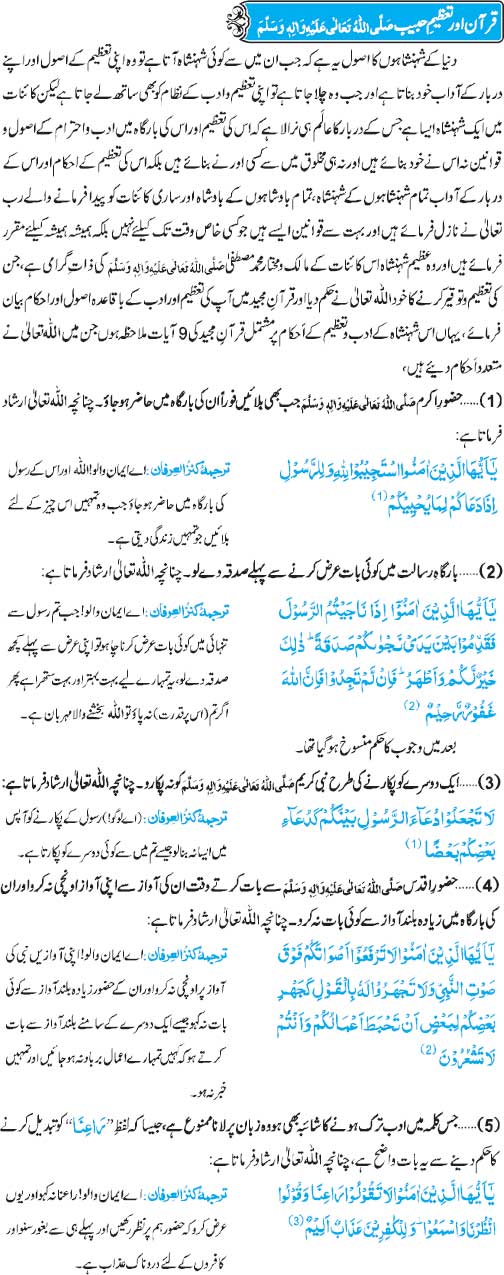
Quran Aur Tazeem-e-Mustafa (S.A.W)


What The Qur’an Teaches: Moses’ Secret Exposed
In the name of God, the Lord of Grace, the Ever Merciful
The next morning, he was in the city, fearful, and vigilant, when he saw the man who sought his help the day before again crying out to him for help. Moses said to him: ‘Indeed, you are clearly a quarrelsome fellow.’ But then, when he was about to strike the one who was their enemy, the latter exclaimed: ‘Moses! Do you want to kill me as you killed another man yesterday? You want only to become a tyrant in the land, and you do not want to be one who sets things right.’ (The Story, Al-Qasas: 28: 18-19)
Moses’ story as told in this surah begins with his early days in Egypt, the beginning of his birth then his adulthood. He supported a man from his own people against an Egyptian, and he killed the latter with a punch. Like anyone in such a position, he would fear the consequences of his deed: “Next morning, he was in the city, fearful, vigilant, when he saw the man who sought his help the day before again crying out to him for help. Moses said to him: ‘Indeed, you are clearly a quarrelsome fellow.’ (Verse 18)
It was only a day after the first fight ended with the death of the Egyptian, followed by God’s acceptance of Moses’ repentance and answering his prayers, and his pledge never to support wrongdoing. But he was in fear lest his offense is discovered. We see him on his guard, expecting a reaction at every moment. This is again a reflection of his spontaneous character. We are given an impression that as he walked ‘in the city,’ which is normally a place of security, he experienced real fear.
That Moses should feel such fear suggests that at this stage he did not have any association with the Pharaoh’s palace. Under tyranny, it is a trifling matter that anyone close to the palace should kill a person. He would have not entertained any fear, let alone that he should walk in the city expecting harm, watching every step. Yet as he walked vigilantly, he looked up, and there “he saw the man who sought his help the day before again crying out to him for help.” (Verse 18) It is the same man who sought his help the day before fighting another Egyptian man and again appealing to Moses for more support. Probably he wanted him to do to this one what he did to the other.
But the image of the man falling dead only the day before was still vivid in Moses’ mind, as was his regret, repentance, and his pledge to God. His fear that he may come to harm as a result was also genuinely felt by Moses, which explains his outburst accusing the Israelite of being unfair and quarrelsome: “Moses said to him: ‘Indeed, you are clearly a quarrelsome fellow.” (Verse 18) The man appeared to be involved in endless quarrels which inevitably enhanced angry feelings against the children of Israel at a time when they could not protect themselves or mount a full-scale revolution. Nothing good could be expected from engaging in such fights.
Yet Moses was subsequently full of anger against the Egyptian and he moved to strike him as he did with the other one. This again gives us a glimpse of his passionate and spontaneous personality, but it also shows how strongly he was affected by the injustice suffered by the Israelites and how keen he was to do whatever he could to repel the aggression under which they had been suffering for long.
“But then, when he was about to strike the one who was their enemy, the latter exclaimed: ‘Moses! Do you want to kill me as you killed another man yesterday? You want only to become a tyrant in the land, and you do not want to be one who sets things right.’”
When injustice is widespread and values are undermined, good people will be greatly distressed to see wrongdoing practically shaping society’s laws and traditions, and corrupting people’s nature so as to make them accept injustice without a thought of taking action to repel it. Indeed people’s nature may suffer such degeneration that they may reproach the victim for resisting injustice. They may even describe as ‘tyrant in the land’ a person who tries to prevent injustice from being done to him or to others, as this second Egyptian called Moses. The fact is that the situation where tyranny smites at will, with no one to resist it, has become so familiar that people tend to accept it as the norm that reflects good manners, propriety, and sound social structure. Should anyone rise to destroy such a foul structure, their outcry would be loud, calling such rebel a killer or a tyrant. He would be the recipient of much of their blame, while the wrongdoer will get away with little criticism if any. The victim will be denied any justification, even though they may know that he could not tolerate injustice any longer.
Moses has been so upset with the injustice suffered for so long by the Israelites. Thus we see him first taking spontaneous action and then regret it, then again we see him moved to almost repeating the action he regretted, stepping to strike the one who was hostile to his community.
Therefore, God did not abandon him. On the contrary, He took care of him and responded to his prayer. God knows human nature and that people have a limit for their tolerance. Therefore, when injustice becomes acute and the way to restore justice is blocked, a victim may well go on the attack, risking all. Hence we do not see Moses’ action painted in stark colors. It is only human communities where human nature has been distorted under prolonged injustice that exaggerate such action which remains, despite going beyond the normal limits, the natural release of long-suffering.
This is what we understand from the way the Qur’an describes the two events and what comes after them. It neither provides justification for Moses’ action nor does it paint its significance in an exaggerated style. Perhaps its description by Moses as wronging oneself is due to the fact that his action was motivated by ethnic affiliation when he is God’s choice to be His messenger. Or it may be that his action precipitated a fight with some individuals who served tyranny, which is of little avail in achieving the ultimate goal of freedom, while God wanted complete freedom for the oppressed community in the way He had chosen. This is akin to the situation in Makkah when God restrained the Muslims from fighting until the appropriate time had come.
– By Adil Salahi
The Universal Message Of Quran
[1:1] In the name of GOD, Most Gracious, Most Merciful.
[7:35] O children of Adam, when messengers come to you from among you and recite My revelations to you, those who take heed and lead a righteous life, will have nothing to fear, nor will they grieve.
Peace be upon you:
The message of the Quran is universal. According to the Quran, God Almighty rewards any righteous believer irrespective of the name of the religion:
[2:62] Surely, those who believe, those who are Jewish, the Christians, and the converts; anyone who (1) believes in GOD, and (2) believes in the Last Day, and (3) leads a righteous life, will receive their recompense from their Lord. They have nothing to fear, nor will they grieve.
God Almighty decrees the same religion for all the people:
[42:13] He decreed for you the same religion decreed for Noah, and what we inspired to you, and what we decreed for Abraham, Moses, and Jesus: “You shall uphold this one religion, and do not divide it.” The idol worshipers will greatly resent what you invite them to do. GOD redeems to Himself whomever He wills; He guides to Himself only those who totally submit.
The name of the religion does not count. The submission to God Alone is the only factor that counts.
[2:111] Some have said, “No one will enter Paradise except Jews or Christians!” Such is their wishful thinking. Say, “Show us your proof, if you are right.”
[2:112] Indeed, those who submit themselves absolutely to GOD alone, while leading a righteous life, will receive their recompense from their Lord; they have nothing to fear, nor will they grieve.
[2:113] The Jews said, “The Christians have no basis,” while the Christians said, “The Jews have no basis.” Yet, both of them read the scripture. Such are the utterances of those who possess no knowledge. GOD will judge them on the Day of Resurrection, regarding their disputes.
A righteous Jew or a Christian believes in the message of the Quran:
[3:199] Surely, some followers of the previous scriptures do believe in GOD, and in what was revealed to you, and in what was revealed to them. They reverence GOD, and they never trade away GOD’s revelations for a cheap price. These will receive their recompense from their Lord. GOD is the most efficient in reckoning.
A righteous Jew uphold Torah:
[5:44] We have sent down the Torah, containing guidance and light. Ruling in accordance with it were the Jewish prophets, as well as the rabbis and the priests, as dictated to them in GOD’s scripture, and as witnessed by them. Therefore, do not reverence human beings; you shall reverence Me instead. And do not trade away My revelations for a cheap price. Those who do not rule in accordance with GOD’s revelations are the disbelievers.
[5:45] And we decreed for them in it that: the life for the life, the eye for the eye, the nose for the nose, the ear for the ear, the tooth for the tooth, and an equivalent injury for any injury. If one forfeits what is due to him as a charity, it will atone for his sins. Those who do not rule in accordance with GOD’s revelations are unjust.
A righteous Christan upholds Gospel:
[5:46] Subsequent to them, we sent Jesus, the son of Mary, confirming the previous scripture, the Torah. We gave him the Gospel, containing guidance and light, and confirming the previous scriptures, the Torah, and augmenting its guidance and light, and to enlighten the righteous.
[5:47] The people of the Gospel shall rule in accordance with GOD’s revelations therein. Those who do not rule in accordance with GOD’s revelations are the wicked.
A righteous Muslim upholds the Quran:
[5:48] Then we revealed to you this scripture, truthfully, confirming previous scriptures, and superseding them. You shall rule among them in accordance with GOD’s revelations, and do not follow their wishes if they differ from the truth that came to you. For each of you, we have decreed laws and different rites. Had GOD willed, He could have made you one congregation. But He thus puts you to the test through the revelations He has given each of you. You shall compete in righteousness. To GOD is your final destiny – all of you – then He will inform you of everything you had disputed.
[5:49] You shall rule among them in accordance with GOD’s revelations to you. Do not follow their wishes, and beware lest they divert you from some of GOD’s revelations to you. If they turn away, then know that GOD wills to punish them for some of their sins. Indeed, many people are wicked.
God loves righteous humans irrespective of the name of their religion:
[5:69] Surely, those who believe, those who are Jewish, the converts, and the Christians; any of them who (1) believe in GOD and (2) believe in the Last Day, and (3) lead a righteous life, have nothing to fear, nor will they grieve.
[7:26] O children of Adam, we have provided you with garments to cover your bodies, as well as for luxury. But the best garment is the garment of righteousness. These are some of GOD’s signs, that they may take heed.
[7:27] O children of Adam, do not let the devil dupe you as he did when he caused the eviction of your parents from Paradise, and the removal of their garments to expose their bodies. He and his tribe see you, while you do not see them. We appoint the devils as companions of those who do not believe.
[7:31] O children of Adam, you shall be clean and dress nicely when you go to the masjid. And eat and drink moderately; Surely, He does not love the gluttons.
[7:35] O children of Adam, when messengers come to you from among you and recite My revelations to you, those who take heed and lead a righteous life, will have nothing to fear, nor will they grieve.
[17:70] We have honored the children of Adam and provided them with rides on land and in the sea. We provided for them good provisions, and we gave them greater advantages than many of our creatures.
[36:60] Did I not covenant with you, O Children of Adam, that you shall not worship the devil? That he is your most ardent enemy?
[22:40] They were evicted from their homes unjustly, for no reason other than saying, “Our Lord is GOD.” If it were not for GOD’s supporting of some people against others, monasteries, churches, synagogues, and masjids – where the name of GOD is commemorated frequently – would have been destroyed. Absolutely, GOD supports those who support Him. GOD is Powerful, Almighty.
God decrees a set of rites for each congregation. The righteous must uphold those rites.
[22:67] For each congregation, we have decreed a set of rites that they must uphold. Therefore, they should not dispute with you. You shall continue to invite everyone to your Lord. Most assuredly, you are on the right path.
The majority of people including Jews, Christians, and Muslims are idol worshipers. Idol worship is the only unforgivable sin if maintained until death:
[12:106] The majority of those who believe in GOD do not do so without committing idol worship.
[4:48] GOD does not forgive idolatry, but He forgives lesser offenses for whomever He wills. Anyone who sets up idols beside GOD has forged a horrendous offense.
[4:116] GOD does not forgive idol worship (if maintained until death), and He forgives lesser offenses for whomever He wills. Anyone who idolizes any idol besides GOD has strayed far astray.
Why Do Muslims Refer To The Quran As A Living Miracle?
Many of God’s Prophets in the past had performed miracles either to prove that they were sent by God or to help people to achieve certain goals. However, as these miracles were for certain people of the time of the respective Prophets, they are neither tangible nor available today as living proof. But the Quran is. It is a miracle by itself. When people asked Prophet Muhammad what miracle he had performed, the Prophet pointed to the Quran.
Muslims regard the Quran as a living miracle because, among other reasons, it:
- Is a Book par excellence in the provision of complete guidance for this life and the Hereafter,
- Is available in the language (Arabic) as revealed to the Prophet,
- Is inimitable in diction, sound, and rendering,
- Is accurate in its presentation of facts,
- Has remained pure (without interpolation),
- Has no contradiction or inconsistencies,
- Has influenced the lives of people, and
- Is responsible for the speedy spread of Islam, even now.
With regard to the Quran being a miracle from the point of view of its influence on people, Maulana Muhammad Ali in his book, “The Religion of Islam”, says: “The Quran is a miracle because it brought about the greatest transformation that the world has ever witnessed – a transformation of the individual, of the family, of the society, of the nation, of the country, an awakening material as well as moral, intellectual and spiritual. It produced an effect, a hundred thousand times greater than that of any other miracle recorded of any Prophet; hence, its claim to be the greatest of all miracles is incontestable and uncontested.”
Researches on the Quran have been made throughout these 14 centuries. More particularly, in recent years, in the wake of religious inquiries, Quranic scholars, scientists, and mathematicians have each, in their own way and knowledge, discovered that the factual contents of the Quran as well as the arrangement of its Words and text point to the fact that the Quran is indeed the living miracle of Islam.
What Makes Muslims Believe That The Quran Is Not Written By Prophet Muhammad (PBUH)?
What makes Muslims believe that the Quran is not written by Prophet Muhammad? Does the Quran claim that it is from God? Could the Prophet have copied some portions of the Bible? Are there scientific facts in the Quran?
Muslims believe that Prophet Muhammad is not the author of the Quran. God is its Author. The following points bear the fact:
*First of all, the Quran itself, in a number of places and in different ways, says that it is from God. One of the claims runs thus: “This is indeed a Quran most honorable, a Book well-guarded…a Revelation from the Lord of the Worlds.” (Quran 56:77-80)
(Here, one ought to know the features of the Quran to understand the claim better. For instance, if the Quran consisted of a number of books, and each book was made up of a number of chapters, then each of the books had to claim that it was from God in order to render the WHOLE volume as coming from God. But, this is fortunately not so with the Quran. The Quran is just ONE Book made up of 114 chapters. So, if the Quran claims, in any of its chapters, that the Book is from God, then the WHOLE Quran is from God. Yet, the Quran does not make the divine claim only once, but several times in different phrases and in different chapters.)
*If the Prophet had written the Quran – a Book par excellence – surely he would have claimed credit for it, but he did not. He could not claim what was not his. Indeed God says: “This Quran is not such as can be produced by anyone other than God.” (10:37)
*The Prophet was unlettered. However, even if he was educated and had written the Quran, how could he be bold enough to make this statement: “Do they not consider (ponder over) the Quran (with care)? Had it been from other than God, they would surely have found therein discrepancies”. (4:82)
Abdullah Yusuf Ali, commenting on this verse (verse 4:82) in his English translation of the Quran, says: “From a mere human point of view, we should have expected many discrepancies, because (1) Prophet Muhammad who promulgated it was not a learned man or philosopher, (2) it was promulgated at various times and in various circumstances, and (3) it is addressed to all grades of mankind. Yet, when properly understood, its various pieces fit together better than a jigsaw puzzle even when arranged without any regard for chronological order. There was just the One Inspirer and one inspired.”
*The Quran took 23 years to complete. Had the verses of the Quran been written by the Prophet, he would have needed a number of drafts and the work would have needed editing, updating, etc. But this did not happen, yet the information is consistent throughout the Quran. The verses were taken down as dictated by the Prophet only once and no redrafting, editing, or updating took place after that.
*At a number of stages during the 23-year period, challenges to reproduce, even a chapter of the Quran was made. If the Prophet had written the Quran, he would not have made the challenges, for fear that the learned
Arabs and eminent poets of his time would have taken up his challenges and shamed him. One of the challenges goes thus: “And if you are in doubt as to what We have revealed (from time to time) to Our servant (Muhammad), then produce a chapter like thereunto…” (2:23)
*The Quran says that the Prophet was not learned.
So, if the Prophet was educated in some institution but mentioned in the Quran that he wasn’t, he would have been accused of being a liar and his mission would have fallen through.
*Even if the Prophet was learned, how could he have written such an inimitable Book of Information and Wisdom without resorting to consultation with prominent scholars and the best books from the best libraries in the world?! If he did this, it would surely have been known, since every move he made was known to people. The Prophet was a historical figure, not a mythological figure.
*The Prophet was the busiest and most active person in history. So, how could he have found the time to write (even if he were educated) such a comprehensive and extensive Book of Guidance which would have needed years of seclusion and concentration to complete?
*In the Quran, in Chapter 111, it is mentioned that Abu Lahab, one of the Prophet’s uncles who was always against Islam, would never accept Islam. This Revelation came some ten years before the death of Abu Lahab. How could the Prophet have dared to write this chapter because all he (Abu Lahab) needed to do to prove that the Quran was not the Words of God, was to accept Islam dishonestly?
*The Prophet was mentioned by name in the Quran only five times whereas Jesus Christ’s name was (honorably) mentioned 25 times. Could the Prophet go to such an extent of honoring someone more than himself if he had written the Quran?
*There is a chapter in the Quran entitled and dedicated to “Mary”, the mother of Jesus Christ, while there is no chapter called, or dedicated to, the Prophet’s own mother, Aminah, or daughter, Fatimah, nor were their names mentioned in the Quran. Could this have happened if the Prophet was the author of the Quran?
*Mary, the mother of Jesus Christ, is glorified in the Quran as a “woman of all nations”. Why would the Prophet glorify a woman he had never seen and one from another race, saying that she was chosen (by God) above all women unless the formulation of the verses had nothing to do with the Prophet’s own authorship but that he only repeated what was inspired to him by God?
*In the Quran, God is called “Allah” (in Arabic). He is also referred to by His Attributes, like the Cherisher, the Merciful, the Almighty. There are 99 such Attributes but none of these is “Abba” (Father) by which the Arab Christians of the Prophet’s time (and even today) refer to God. If the Prophet was the writer of the Quran, he would surely have used “Abba” as one of the names for God because of its familiarity and also because it was easier to say “Abba” than many of the Attributes.
*Although the Quran’s objective is basically religious, it does touch on certain principles and laws governing the universe. A French scientist, Maurice Bucaille, in his book, “The Bible, the Quran and Science”, says: “What initially strikes the reader confronted for the first time with a text of this kind (the Quran) is the sheer abundance of subjects discussed: the Creation, astronomy, the explanation of certain matters concerning the earth, and the animal and vegetable kingdoms, human reproduction …I could not find a single error in the Quran. I had to stop and ask myself: if a man was the author of the Quran, how could he have written facts in the 7th Century AD that today are shown to be in keeping with modern scientific knowledge?”
*The Quran mentions a number of scientific facts which were unknown to the world then. Some of them are:
-The moon has no light of its own and that what we see is the reflected light of the sun. (91:1-2),
-Every living thing began in water. (continuation of 21:30),
-Stages of reproduction of life in the womb. (22:5),
-Every living thing, including vegetable matter, is created in pairs (male and female). (36:36),
-All celestial body (namely, the moon and planets) have their own course of orbit. (7:54 and 21:33),
-Space travel is possible. (55:33), and
-There is also life (in whatever form) in other parts of the universe. (42:29).
-All these scientific facts were discovered only in the last couple of centuries whereas the Quran mentioned them 14 centuries ago. How could the Prophet, even if he were educated, have known these facts centuries ahead of recent times?
*Learned Arabs and other experts in the Arabic language acknowledge that the style, diction, and rendering in the Quran far excel those in the Hadith. Those in the Quran are inimitable, proving that the Quran is authored by God.
*Umar, later to become Caliph, had wanted to kill the Prophet because of his (Islamic) teachings. One day, Umar heard his sister reading something – the sound, diction, and meaning of which made him halt to listen. His sister, who had secretly converted to Islam, was reading (part of) the Quran. Umar realized that the Words he was listening to could not be the words of man. He submitted to Islam soon after.
*The Quran says: “If the whole of mankind and jinns (spirits) were to come together to produce the like of this Quran, they could not produce the like thereof even if backed up by each other with help and support.” (17:88) This is a bold statement indeed. If the Prophet had written the Quran, would he as a human being, dare make such an explosive statement? Would this statement go unchallenged by the learned Arabs of his time?
Prophet Muhammad, being an unlettered person, could not have written the Quran, a book full of wisdom and one dealing with varied subject matters. The Quran categorically states: “This Quran is not such as can be produced by anyone other than God. (It is a Book) from the Lord of the Worlds.” (10:37)
The Truth About Death
The concept of death can be derived from these verses of the Quran – “He is the One who puts you to death during the night, and knows even the smallest of your actions during the day. He resurrects you every morning, until your life span is fulfilled, then to Him is your ultimate return. He will then inform you of everything you had done. He is Supreme over His creatures, and He appoints guards to protect you. When the appointed time of death comes to any of you, our messengers put him to death without delay. Then everyone is returned to God, their rightful Lord, and Master. Absolutely, He is the ultimate judge; He is the most accurate reckoner.” (Quran 6:60-62)
The time of death is predetermined – “No one dies except by God’s leave, at a predetermined time. Whoever seeks the vanities of this world, we give him therefrom, and whoever seeks the rewards of the Hereafter, we bless him therein. We reward those who are appreciative.” (Quran 3:145)
No one knows the time or place of one’s death – ” With God is the knowledge regarding the Hour. He is the One who sends down the rain, and He knows the contents of the womb. No soul knows what will happen to it tomorrow, and no one knows in which land he or she will die. God is Omniscient, Cognizant.” (Quran 31:34)
Every soul will experience death – “Every soul will taste death, after we put you to the test through adversity and prosperity, then to us you ultimately return.” (Quran 21:35)
We already experienced our first death until we were born into this world – “Most exalted is the One in whose hands is all kingship, and He is Omnipotent. The One who created death and life for the purpose of distinguishing those among you who would do better. He is the Almighty, the Forgiving.” (Quran 67:1-2)
The second death concludes our life in this world – “How can you disbelieve in God when you were dead and He gave you life, then He puts you to death, then He brings you back to life, then to Him you ultimately return?” (Quran 2:28)
The righteous do not experience the second death – ” The righteous will be in a secure position. Enjoying gardens and springs. Wearing velvet and satin; close to each other. We grant them wonderful spouses. They enjoy in it all kinds of fruits, in perfect peace. They do not taste death therein – beyond the first death – and He has spared them the retribution of Hell.” (Quran 44:51-56)
“The angels terminate their lives in a state of righteousness, saying, “Peace be upon you. Enter paradise as a reward for your works.” (Quran 16:32)
The Quran gives an example of the death of a righteous person – “And for claiming that they killed the Messiah, Jesus, son of Mary, the messenger of God. In fact, they never killed him, they never crucified him – they were made to think that they did. All factions who are disputing in this matter are full of doubt concerning this issue. They possess no knowledge; they only conjecture. For certain, they never killed him. Instead, God raised him to Him; God is Almighty, Most Wise.” (Quran 4:157-158)
“They plotted and schemed, but so did God, and God is the best schemer. Thus, God said, “O Jesus, I am terminating your life, raising you to Me, and ridding you of the disbelievers. I will exalt those who follow you above those who disbelieve, till the Day of Resurrection. Then to Me is the ultimate destiny of all of you, then I will judge among you regarding your dispute.” (Quran 3:54 – 55)
The unrighteous experiences the second death – “Those who disbelieve will be told, “God’s abhorrence towards you is even worse than your abhorrence towards yourselves. For you were invited to believe, but you chose to disbelieve. They will say, “Our Lord, you have put us to death twice, and you gave us two lives; now we have confessed our sins. Is there any way out ?” This is because when God Alone was advocated, you disbelieved, but when others were mentioned beside Him, you believed. Therefore, God’s judgment has been issued; He is the Highest, the Great.” (Quran 40:10-12)
The nature of second death can be derived from these verses – “If you could only see those who disbelieved when the angels put them to death! They will beat them on their faces and their rear ends; “Taste the retribution of Hell. This is a consequence of what your hands have sent forth. God is never unjust towards the creatures.” (Quran 8:50-51)
The Quran gives an example of the death of unrighteous people – “Whenever a plague afflicted them, they said, “O Moses, implore your Lord – you are close to Him. If you relieve this plague, we will believe with you and will send the children of Israel with you. Yet, when we relieved the plague for any length of time, they violated their pledge. Consequently, we avenged their actions and drowned them in the sea. That is because they rejected our signs, and were totally heedless thereof.” (Quran 7:134-136)
The death of the righteous and unrighteous can be compared to these verses – “The (angels who) snatch (the souls of the disbelievers) forcibly. And those who gently take (the souls of the believers) joyfully.” (Quran 79:1-2)
This is the crucial reminder of the Quran – Those who disbelieve and die as disbelievers, the earth full of gold will not be accepted from any of them, even if such a ransom were possible. They have incurred painful retribution; they will have no helpers.” (Quran 3:91)