
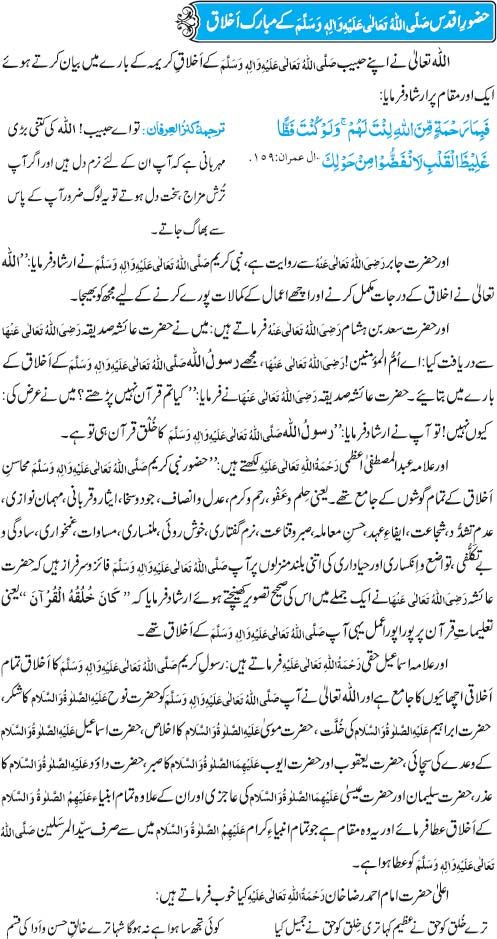
Huzoor-e-Aqdas (Sallallahu Alaihi Wasallam) Kay Mubarak Ikhlaq
Eat And Spend From Good (Alttayyibat)
[Sahih Muslim: Book 5 Kitab Al-Zakat, Number 2214] Abu Huraira (Radi Allah Anhu) reported Allah’s Messenger (sal-allahu-alleihi-wasallam) as saying: O people, Allah is Good and He therefore, accepts only that which is good. And Allah commanded the believers as He commanded the Messengers by saying:” O Messengers, eat of the good things, and do good deeds; verily I am aware of what you do”. And He said: ‘ O those who believe, eat of the good things that We gave you” He then made a mention of a person who travels widely, his hair disheveled and covered with dust. He lifts his hand towards the sky (and thus makes the supplication):” O Lord,0 Lord,” whereas his diet is unlawful, his drink is unlawful, and his clothes are unlawful and his nourishment is unlawful. How can then his supplication be accepted?
[Sahih Muslim: Book 5 Kitab Al-Zakat, Number 2211] Abu Huraira (Radi Allah Anhu) reported Allah’s Messenger (sal-allahu-alleihi-wasallam) as saying: If anyone gives as Sadaqa the equivalent of a date from that (earning) earned honestly, for Allah accepts that which is lawful, the Lord would accept it with His Right Hand, and even if it is a date, it would foster in the Hand of the lord, as one of you fosters his colt, till it becomes bigger than a mountain.
[2. Surah Al-Baqarah : Ayah 267] O you who believe! spend (benevolently) of the good things that you earn and or what We have brought forth for you out of the earth, and do not aim at what is bad that you may spend (in alms) of it, while you would not take it yourselves unless you have its price lowered, and know that Allah is Self-sufficient, Praiseworthy.
[2. Surah Al-Baqarah: Ayah 268] Shaitan threatens you with poverty and enjoins you to be niggardly, and Allah promises you forgiveness from Himself and abundance; and Allah is Ample-giving, Knowing.
Our Lord! grant us good in this world and good in the hereafter, and save us from the chastisement of the fire.
Buzurgan e Deen Ka Andaz Tafheem o Tarbiyat

Buzurgan e Deen Ka Andaz Tafheem o Tarbiyat
Aishah Bint Abu Bakr (May Allah Be Pleased With Her) The Teacher Of The Whole World
The life of Aishah (RA) is proof that a woman can be far more learned than men and that she can be a teacher of scholars and experts. Her life is also proof that a woman can exert influence over men and women and provide them with inspiration and leadership. Her life is also proof that the same woman can be totally feminine and be a source of pleasure, joy, and comfort to her husband.
She did not graduate from any university there were no universities as such in her day. But still, her utterances are studied in faculties of literature, her legal pronouncements are studied in colleges of law, and her life and works are studied and researched by students and teachers of Muslim history as they have been for over a thousand years.
The bulk of her vast treasure of knowledge was obtained while she was still quite young. In her early childhood, she was brought up by her father who was greatly liked and respected for he was a man of wide knowledge, gentle manners, and an agreeable presence. Moreover, he was the closest friend of the noble Prophet (SAW- may the peace and blessings of Allah be upon him) who was a frequent visitor to their home since the very early days of his mission.
In her youth, already known for her striking beauty and her formidable memory, she came under the loving care and attention of the Prophet (SAW) himself. As his wife and close companion, she acquired from him knowledge and insight such as no woman has ever acquired.
Aishah (RA) became the Prophet’s (SAW) wife in Makkah when she was most likely in the tenth year of her life but her wedding did not take place until the second year after the Hijrah when she was about fifteen years old. Before and after her wedding she maintained a natural jollity and innocence and did not seem at all overawed by the thought of being wedded to him who was the Messenger of God (SAW) whom all his companions (RA- may Allah be pleased with them all), including her own mother and father, treated with such love and reverence as they gave to no one else.
About her wedding, she related that shortly before she was to leave her parent’s house, she slipped out into the courtyard to play with a passing friend: “I was playing on a see-saw and my long streaming hair was disheveled,” she said. “They came and took me from my play and made me ready.”
They dressed her in a wedding dress made from fine red-striped cloth from Bahrain and then her mother took her to the newly-built house where some women of the Ansar were waiting outside the door. They greeted her with the words “For good and for happiness may all be well!” Then, in the presence of the smiling Prophet (SAW), a bowl of milk was brought. The Prophet (SAW) drank from it himself and offered it to Aishah (RA). She shyly declined it but when he insisted she did so and then offered the bowl to her sister Asma (RA) who was sitting beside her. Others also drank of it and that was as much as there was of the simple and solemn occasion of their wedding. There was no wedding feast.
Marriage to the Prophet (SAW) did not change her playful ways. Her young friends came regularly to visit her in her own apartment. “I would be playing with my dolls,” she said, “with the girls who were my friends, and the Prophet (SAW) would come in and they would slip out of the house and he would go out after them and bring them back, for he was pleased for my sake to have them there.” Sometimes he would say “Stay where you are” before they had time to leave, and would also join in their games. Aishah (RA) said: “One day, the Prophet (SAW) came in when I was playing with the dolls and he said: ‘O Aishah (RA), what game is this?’ ‘It is Solomon’s horses,’ I said and he laughed.” Sometimes as he came in he would screen himself with his cloak so as not to disturb Aishah (RA) and her friends.
Aishah’s (RA) early life in Madinah also had its more serious and anxious times. Once her father and two companions (RA – may Allah be pleased with them) who were staying with him fell ill with a dangerous fever which was common in Madinah at certain seasons. One morning Aishah (RA) went to visit him and was dismayed to find the three men lying completely weak and exhausted. She asked her father how he was and he answered her in verse but she did not understand what he was saying. The two others also answered her with lines of poetry that seemed to her to be nothing but unintelligible babbling. She was deeply troubled and went home to the Prophet (SAW) saying:
“They are raving, out of their minds, through the pangs of the fever.” The Prophet (SAW) asked what they had said and was somewhat reassured when she repeated almost word for word the lines they had uttered which made sense although she did not fully understand them then. This was a demonstration of the great retentive power of her memory which as the years went by was to preserve so many of the priceless sayings of the Prophet (SAW).
Of the Prophet’s (SAW) wives (RA- may Allah be pleased with them all) in Madinah, it was clear that it was Aishah (RA) that he loved most. From time to time, one or the other of his companions would ask:
“O Messenger of God (SAW), whom do you love most in the world?” He did not always give the same answer to this question for he felt great love for many for his daughters and their children, for Abu Bakr (RA- may Allah be pleased with him) for Ali (RA), for Zayd (RA) and his son Usamah (RA). But of his wives (RA) the only one he named in this connection was Aishah (RA). She too loved him greatly in return and often would seek reassurance from him that he loved her. Once she asked him: “How is your love for me?”
“Like the rope’s knot,” he replied meaning that it was strong and secure. And time after time thereafter, she would ask him: “How is the knot?” and he would reply: “Ala haaliha in the same condition.”
As she loved the Prophet (SAW) so was her love a jealous love and she could not bear the thought that the Prophet’s (SAW) attention should be given to others more than seemed enough to her. She asked him:
“O Messenger of God (SAW), tell me of yourself. If you were between the two slopes of a valley, one of which had not been grazed whereas the other had been grazed, on which would you pasture your flocks?”
“On that which had not been grazed,” replied the Prophet (SAW). “Even so,” she said, “and I am not as any other of your wives (RA). “Everyone of them had a husband before you, except myself.” The Prophet (SAW) smiled and said nothing. Of her jealousy, Aishah (RA) would say in later years:
“I was not, jealous of any other wife of the Prophet (SAW) as I was jealous of Khadijah (RA), because of his constant mentioning of her and because God had commanded him to give her good tidings of a mansion in Paradise of precious stones. And whenever he sacrificed a sheep he would send a fair portion of it to those who had been her close friends. Many a time I said to him: “It is as if there had never been any other woman in the world except Khadijah (RA).”
Once, when Aishah (RA) complained and asked why he spoke so highly of “an old Quraysh woman” i.e. Khadijah (RA), the Prophet (SAW) was hurt and said: “She was the wife who believed in me when others rejected me. When people accused me of lies, she affirmed my truthfulness. When I stood forsaken, she spent her wealth to lighten the burden of my sorrow.”
Despite her feelings of jealousy which nonetheless were not of a destructive kind, Aishah (RA) was really a generous soul and a patient one. She bore with the rest of the Prophet’s (SAW) household poverty and hunger which often lasted for long periods. For days on end, no fire would be lit in the sparsely furnished house of the Prophet for cooking or baking bread and they would live merely on dates and water. Poverty did not cause her distress or humiliation; self-sufficiency when it did come did not corrupt her style of life.
Once the Prophet (SAW) stayed away from his wives for a month because they had distressed him by asking of him that which he did not have. This was after the Khaybar expedition when an increase of riches whetted the appetite for presents. Returning from his self-imposed retreat, he went first to Aishah’s (RA) apartment. She was delighted to see him but he said he had received Revelation which required him to put two options before her. He then recited the verses:
“O Prophet! Say to your wives: If you desire the life of this world and its adornments, then come and I will bestow its goods upon you, and I will release you with a fair release (divorce). But if you desire God and His Messenger and the abode of the Hereafter, then verily God has laid in store for you an immense reward for such as you who do good.”
Aishah’s (ra) reply was: “Indeed I desire God and His Messenger (SAW) and the abode of the Hereafter,” and her response was followed by all the others.
She stuck to her choice both during the lifetime of the Prophet (SAW) and afterward. Later when the Muslims were favored with enormous riches, she was given a gift of one hundred thousand dirhams. She was fasting when she received the money and she distributed the entire amount to the poor and the needy even though she had no provisions in her house. Shortly after, a maidservant said to her: “Could you buy meat for a dirham with which to break your fast?”
“If I had remembered, I would have done so,” she said. The Prophet’s (SAW) affection for Aishah (RA) remained to the last. During his final illness, it was to Aishah’s (RA) apartment that he went at the suggestion of his wives (RA). For much of the time he lay there on a couch with his head resting on her breast or on her lap. She it was who took a toothstick from her brother, chewed upon it to soften it, and gave it to the Prophet (SAW). Despite his weakness, he rubbed his teeth with it vigorously. Not long afterward, he lost consciousness and Aishah (RA) thought it was the onset of death, but after an hour he opened his eyes.
Aishah (RA) it is who has preserved for us these dying moments of the most honored of God’s creation, His beloved Messenger (SAW) may He shower His choicest blessings on him.
When he opened his eyes again, Aishah (RA) remembered Iris having said to her: “No Prophet is taken by death until he has been shown his place in Paradise and then offered the choice, to live or die.”
“He will not now choose us,” she said to herself. Then she heard him murmur: “With the supreme communion in Paradise, with those upon whom God has showered His favor, the Prophets, the martyrs, and the righteous…” Again she heard him murmur: “O Lord, with the supreme communion,” and these were the last words she heard him speak. Gradually his head grew heavier upon her breast, until others in the room began to cry, and Aishah (RA) laid his head on a pillow and joined them in crying.
On the floor of Aishah’s (RA) room near the couch where he was lying, a grave was dug which was buried the Seal of the Prophets (SAW) amid much bewilderment and great sorrow.
Aishah (RA) lived on for almost fifty years after the passing away of the Prophet (SAW). She had been his wife for a decade. Much of this time was spent in learning and acquiring knowledge of the two most important sources of God’s guidance, the Quran and the Sunnah of His Prophet (SAW). Aishah (RA) was one of three wives (the other two being Hafsah (RA) and Umm Salamah (RA) who memorized the Revelation (the Quran). Like Hafsah (RA), she had her own script of the Quran written after the Prophet (SAW) had died.
So far as the Ahadith or sayings of the Prophet (SAW) are concerned, Aishah (RA) is one of four persons (the others being Abu Hurayrah (RA), Abdullah ibn Umar (RA), and Anas ibn Malik (RA) who transmitted more than two thousand sayings. Many of these pertain to some of the most intimate aspects of personal behavior which only someone in Aishah’s (RA) position could have learned. What is most important is that her knowledge of hadith was passed on in written form by at least three persons including her nephew Urwah (RA) who became one of the greatest scholars among the generation after the Companions (RA- may Allah be pleased with them all).
Many of the learned companions of the Prophet (SAW) and their followers benefitted from Aishah’s (RA) knowledge. Abu Musa al-Ashari once said: “If we companions (RA – may Allah be pleased with them all) of the Messenger of God (SAW) had any difficulty on a matter, we asked Aishah (ra) about it.”
Her nephew Urwah (RA) asserts that she was proficient not only in fiqh (Islamic law) but also in medicine (tibb) and poetry. Many of the senior companions (RA) of the Prophet (SAW) came to her to ask for advice concerning questions of inheritance which required a highly skilled mathematical mind. Scholars regard her as one of the earliest fuqaha (Islamic jurists) of Islam along with persons like Umar ibn al-Khattab (RA), Ali (RA), and Abdullah ibn Abbas (RA). The Prophet (SAW) referring to her extensive knowledge of Islam is reported to have said: “Learn a portion of your religion (din) from this red-colored lady.” “Humayra” meaning “Red-coloured” was an epithet given to Aishah (RA) by the Prophet (SAW).
Aishah (RA) not only possessed great knowledge but took an active part in education and social reform. As a teacher she had a clear and persuasive manner of speech and her power of oratory has been described in superlative terms by al-Ahnaf who said: “I have heard speeches of Abu Bakr and Umar, Uthman, and Ali (RA- may Allah be pleased with them all) and the Khulafa up to this day, but I have not heard speech more persuasive and more beautiful from the mouth of any person than from the mouth of Aishah (RA).”
Men and women came from far and wide to benefit from her knowledge. The number of women is said to have been greater than that of men. Besides answering inquiries, she took boys and girls, some of them orphans, into her custody and trained them under her care and guidance. This was in addition to her relatives who received instruction from her. Her house thus became a school and an academy.
Some of her students were outstanding. We have already mentioned her nephew Urwah (RA) as a distinguished reporter of hadith. Among her women, pupils is the name Umrah bint Abdur Rahman (RA). She is regarded by scholars as one of the trustworthy narrators of hadith and is said to have acted as Aishah’s secretary receiving and replying to letters addressed to her. The example of Aishah in promoting education and in particular the education of Muslim women in the laws and teachings of Islam is one which needs to be followed.
After Khadijah al-Kubra (the Great) and Fatimah az-Zahra (the Resplendent), Aishah as-Siddiqah (the one who affirms the Truth) is regarded as the best woman in Islam. Because of the strength of her personality, she was a leader in every field in knowledge, in society, in politics, and in war. She died in the year 58 AH in the month of Ramadan and as she instructed, was buried in the Jannat al-Baqi in the City of Light, beside other companions of the Prophet.
Aib Joi, Tana Denay Aur Chugli Ki Muzammat
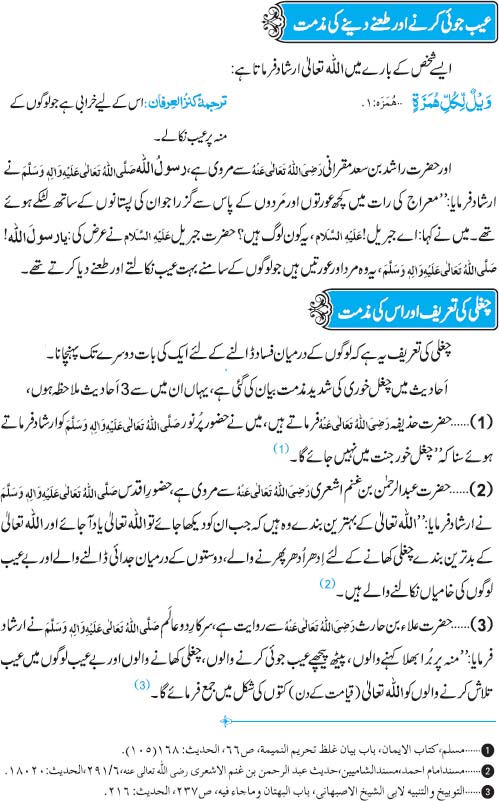
Aib Joi, Tana Denay Aur Chugli Ki Muzammat
Love For God In Islam – The Highest Attribute Of Spiritual Attainment
In Islam fear of God, obedience to God, and sacrificing for God’s cause are stages (that should be maintained) on the spiritual path to something better; love for God.
There are many reasons people become Muslim. Among those reasons are feelings of the need to be a part of something better than what they have, believing that Islam holds more truth than other beliefs, or rejecting something once believed. Attributes that are obtained by the Muslims are fear of God and love for God. The last is the highest reason to worship. Yet obtaining Love for God is a process. It is something to be achieved. One does not simply wake up loving God. But once the love of God is had it is like no other type of love that has been experienced.
Those Who Love God
Love of God causes one to enjoy life more fully. It causes the Muslims to realize that God is the only non-changing reality. He is the Sure Reality and Truth (al-haqq).
“Yet there are men who take (for worship) others besides Allah, as equal (with Allah): They love them as they should love Allah. But those of Faith are overflowing in their love for Allah.” (Quran 2:165)
Hence, faith is first mentioned as a necessary component of achieving Love for God. It is misplaced when feelings for created things, or beings, cause a diversion from focusing on the Conscious Reality that created all. The Conscious Reality that sustains all. Faith is the decision of the believer to worship that which is unseen and un-seeable in this life.
Developing Love for God
Developing love for God begins with the study of the divine. Science now tells us that there is a component in the brain that creates within humans the desire to believe in a higher power. When we intentionally work to develop that part of our being, new paths are created and opened within the person. The Muslim begins to feel the need to worship (Ibadda), pray (salat), and remember (Dhikr – a form of meditation) God. God begins to take precedence over the Muslim’s life. She/He begins to look at God with reverence and becomes a seeker on the path after God’s Greatness.
“Those that turn (to Allah) in repentance; that serve Him, and praise Him; that wander in devotion to the cause of Allah,: that bow down and prostrate themselves in prayer; that enjoin good and forbid evil; and observe the limit set by Allah;- (These do rejoice). So proclaim the glad tidings to the Believers”. (Quran 9:112)
Attributes of Those Who Love God
Love of God brings about the best in the individual whose actions benefit those around them. Out of love for God the Muslim will do everything, from waking moment to sleep, courageously battling lower desires to please her/his lord. Sacrificing what she/he is in possession of for the sake of the Beloved.
“It is not righteousness that ye turn your faces Towards east or West, but it is righteousness- to believe in Allah and the Last Day, and the Angels, and the Book, and the Messengers; to spend of your substance, out of love for Him, for your kin, for orphans, for the needy, for the wayfarer, for those who ask, and for the ransom of slaves; to be steadfast in prayer, and practice regular charity; to fulfill the contracts which ye have made; and to be firm and patient, in pain (or suffering) and adversity, and throughout all periods of panic. Such are the people of truth, the Allah-fearing.” (Quran 2:177)
Example of One Who Loves God
God rewards those who work to develop a love for Him and who yearn for their meeting with Him. The Quran gives an example of one who strives and struggles through life while awaiting the final meeting with God. One who struggles to deal with the twists and turns that daily life presents. One who strives to keep his family intact while increasing their spiritual growth. In the Father of John (Yahya) the Baptist there is the following example of one pleading to his Lord out of Love in the midst of affliction and adversity.
So We listened to him: and We granted him Yahya: We cured his wife’s (Barrenness) for him. These (three) were ever quick in emulation of good works; they used to call on Us with love and reverence and humble themselves before Us. (Quran 21:90)
When afflicted with pain, sorrow, and adversity, the Muslim turns to God with Love.
Khalil Green has obtained a bachelor’s Degree with Departmental Honors in Religious Studies from Washburn University in Topeka, Kansas. His focus was, and remains, on Islamic and mystic traditions. He has held the title of Imam for the State of Kansas as its first Muslim Chaplain in a correctional institution.
Ehtram Aur Shafqat Kay Ahkam

Ehtram Aur Shafqat Kay Ahkam
Islam Is A Code Of Life
1. Spiritual Life
Islamic prescription: Prayer, fasting, charity giving, pilgrimage, love for God and His Messenger, love for truth and humanity for the sake of God, hope and trust in God at all times, and doing good for the sake of God.
2. Intellectual Life
Islamic prescription: True knowledge based on clear proofs and indisputable evidence acquired by experience or experiment or by both. The Quran points to the rich sources of knowledge in the whole universe.
Islam demands faith in God on the basis of knowledge and research and leaves wide open all fields of thought before the intellect penetrates as far as it can reach.
3. Personal Life
Islamic prescription: Purity and cleanliness, a healthy diet, proper clothing, proper behavior, and good healthy sexual relations within marriage.
4. Family Life
Islamic prescription: A family is a human social group whose members are bound together by the bond of blood ties and/or marital relationship and nothing else (adoption, mutual alliance, common law, trial marriage. . . etc.)
Marriage is a religious duty on all who are capable of meeting its responsibilities. Each member of the family has rights and obligations.
5. Social Life
Islamic prescription: Man is ordained by God to extend his utmost help and kindness to other family members, relations, servants, and neighbors. No superiority on account of class, color, origin, or wealth.
Humanity represents one family springing from one and the same father and mother. The unity of humanity is not only in its origin but also in its ultimate aims.
6. Economical Life
Islamic prescription: Earning one’s living through decent labor is not only a duty but a great virtue as well. Earning is man’s private possession. The individual is responsible for the prosperity of the state and the state is responsible for the security of the individual.
The Islamic economic system is not based on arithmetical calculations alone but also on morals and principles.
Man comes into this world empty-handed and departs empty-handed. The real owner of things is God alone. Man is simply a trustee.
7. Political Life
Islamic prescription: The sovereignty in the Islamic State belongs to God; the people exercise it by trusting Him to enforce His laws.
The ruler is only an acting executive chosen by the people to serve them according to God’s law. The State is to administer justice and provide security for all citizens.
Rulers and administrators must be chosen from the best-qualified citizens. If an administration betrays the trust of God and the people, it has to be replaced.
Non-Muslims can administer their personal life of marriage, divorce, food, and inheritance according to Islamic law or to their own religious teachings.
They may pay Zakah (Islamic tax) or a different tax “Tributes” “Jizyah”. They are entitled to full protection and security of the state including freedom of religion.
8. International Life
Islamic prescription: Man has a common origin, human status, and aim. Other people’s interests and rights to life, honor, and property are respected as long as the rights of Muslims are intact. Transgression is forbidden.
War is only justified if state security is endangered. During war destruction of crops, animals, and homes, killing non-fighting women, children, and aged people is forbidden.
Ikhlaq e Hasna Ki Taleem
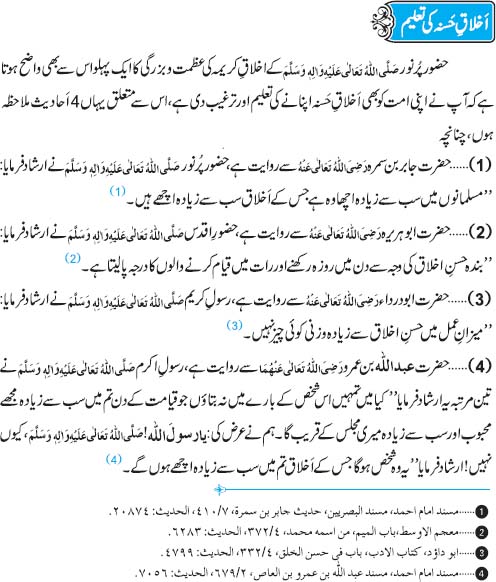
Ikhlaq e Hasna Ki Taleem
The Meaning Of Islam
I. The Meaning of Islam
Islam is derived from the Arabic root “Salema”: peace, purity, submission, and obedience. In the religious sense, Islam means submission to the will of God and obedience to His law.
Everything and every phenomenon in the world other than man are administered totally by God-made laws, i.e. they are obedient to God and submissive to his laws, they are in the State of Islam. Man possesses the qualities of intelligence and choice, thus he is invited to submit to the goodwill of God and obey His law, ie, become a Muslim.
Submission to the good will of God, together with obedience to His beneficial Law, ie, becoming a Muslim, is the best safeguard for man’s peace and harmony.
Islam dates back to the age of Adam and its message has been conveyed to man by God’s prophets and messengers, including Abraham, Moses, Jesus, and Muhammad (PBUH).
Islam’s message has been restored and enforced in the last stage of the religious evolution by God’s last prophet and messenger, Muhammad.
The word Allah in the Arabic language means God, or more accurately, The One and Only Eternal God, Creator of the Universe, Lord of all lords, King of all kings, Most Compassionate, Most Merciful. The word Allah to mean God is also used by Arabic-speaking Jews and Christians.
II. Articles of Faith
A Muslim believes in One God, Supreme, and Eternal, Infinite and Mighty, Merciful and Compassionate, Creator and Provider.
God has no father nor mother, no sons nor daughters. He has not fathered anyone nor was He fathered. None equal to Him. He is the God of all mankind, not of a special tribe or race.
God is High and Supreme but He is very near to the pious thoughtful believers; He answers their prayers and helps them. He loves the people who love Him and forgives their sins. He gives them peace, happiness, knowledge, and success.
God is the Loving and the Provider, the Generous and the Benevolent, the Rich and the Independent, the Forgiving and the Clement, the Patient and the Appreciative, the Unique and the Protector, the Judge and the Peace. God’s attributes are mentioned in the Quran.
God creates in man the mind to understand, the soul and conscience to be good and righteous, and the feelings and sentiments to be kind and humane. If we try to count His favors upon us, we cannot, because they are countless.
In return for all the great favors and mercy, God does not need anything from us, because he is Needless and Independent.
God asks us to know Him, to love Him, and to enforce His Law for our own benefit and our own good.
A Muslim believes in all the Messengers and Prophets of God without any discrimination.
All messengers were mortals, human beings, endowed with Divine revelations and appointed by God to teach mankind. The Holy Quran mentions the names of 25 messengers and prophets and states that there are others. These include Noah, Abraham, Ishmael, Isaac, Moses, Jesus, and Muhammad (PBUH). Their message is the same and it is Islam and it came from One and the Same Source; God, and it is to submit to His will and to obey his law, ie, to become a Muslim.
A Muslim believes in all scriptures and revelations of God, as they were complete and in their original versions.
Revelations were given to guide the people to the right path of God. The Quran refers to the books revealed to Abraham, Moses, David, Jesus, and Muhammad (PBUH).
Today, the books before the Quran do not exist in their original form. They are lost corrupted or concealed. Weakness in the early period of Judaism and Christianity are partly responsible.
Today the Quran is the only authentic and complete book of God. No scholar has questioned the fact that the Quran today is the same as it was more than 1400 years ago. Muslims till today memorize the Quran word by word as a whole or in part.
God who revealed the Quran is protecting it from being lost, corrupted, or concealed.
A Muslim believes in the angels of God.
They are purely spiritual and splendid beings created by God. They require no food drink or sleep. They have no physical desires or material needs.
Angels spend their time in the service of God. Each is charged with a certain duty. Angels cannot be seen by the naked eye. Knowledge and truth are not entirely confined to sensory knowledge or sensory perception alone.
A Muslim believes in the day of Judgement.
This world as we know it will come to an end and the dead will rise to stand for their final and fair trial. Everything we do, say, make, intend, and think are accounted for and kept in accurate records. They are brought up on the day of judgment.
People with good records will be generously rewarded and warmly welcomed to God’s Heaven. People with bad records will be fairly punished and cast into Hell.
The real nature of Heaven and Hell are known to God only, but they are described by God in man’s familiar terms in the Quran.
If some good deeds are seen not to get full appreciation and credit in this life, they will receive full compensation and be widely acknowledged on the Day of Judgement.
If some people who commit sins, neglect God, and indulge in immoral activities seem superficially successful and prosperous in this life, absolute justice will be done to them on the Day of Judgement.
The time of the Day of Judgement is only known to God and God alone.
A Muslim believes in “Qadaa” and “Qadar”.
“Qadaa” and “Qadar” mean the Timeless Knowledge of God and His power to plan and execute His plans. God is not indifferent to this world nor is He neutral to it.
God is Wise, Just, and Loving and whatever He does must have a good motive, although we may fail sometimes to understand it fully.
We should have strong faith in God and accept whatever He does because our knowledge is limited and our thinking is based on individual consideration, whereas His knowledge is limitless and He plans on a universal basis.
Man should think, plan, and make sound choices, but if things do not happen the way he wants, he should not lose faith and surrender himself to mental strains or shattering worries.
A Muslim believes that the purpose of life is to worship God.
Worshipping God does not mean we spend our entire lives in constant seclusion and absolute meditation. To worship God is to live life according to His commands, not to run away from it.
To worship God is to know Him, to love Him, to obey His commands, to enforce His laws in every aspect of life, to serve His cause by doing right and shunning evil, and to be just to Him, to ourselves, and to our fellow human beings.
A Muslim believes that man enjoys an especially high-ranking status in the hierarchy of all known creatures.
Man occupies this distinguished position because he alone is gifted with rational faculties and spiritual aspirations as well as powers of action.
Man is not a condemned race from birth to death, but a dignified being potentially capable of good and noble achievements.
A Muslim believes that every person is born a “Muslim”.
Every person is endowed by God with spiritual potential and intellectual inclination that can make him a good Muslim.
Every person’s birth takes place according to the will of God in the realization of His plans and in submission to His commands.
A Muslim believes that every person is born free from sin.
When the person reaches the age of maturity and if he is sane, he becomes accountable for all his deeds and intentions. Man is free from sin until he commits sin.
There is no inherited sin, no original sin. Adam committed the first sin, he prayed to God for pardon, and God granted Adam pardon.
A Muslim believes that man must work out his salvation through the guidance of God.
No one can act on behalf of another or intercede between him and God.
In order, to obtain salvation a person must combine faith and action, belief and practice. Faith without doing good deeds is as insufficient as doing good deeds without faith.
A Muslim believes that God does not hold any person responsible until he has shown him the Right Way.
If people do not know and have no way of knowing about Islam, they will not be responsible for failing to be Muslim. Every Muslim must preach Islam words and in action.
A Muslim believes that faith is not complete when it is followed blindly or accepted unquestioningly.
Man must build his faith on well-grounded convictions beyond any reasonable doubt and above uncertainty.
Islam ensures freedom to believe and forbids compulsion in religion. (one of the oldest synagogues and one of the oldest churches in the world are in Muslim countries).
A Muslim believes that the Quran is the word of God revealed to the prophet Muhammad (PBUH) through the Angel Gabriel.
The Quran was revealed from God on various occasions to answer questions, solve problems, settle disputes, and to be man’s best guide to the truth.
The Quran was revealed in Arabic and it is still in its original and complete Arabic version until today. Millions memorize it.
A Muslim believes in a clear distinction between the Quran and the Traditions of the Prophet Muhammad.
Whereas the Quran is the word of God, the Traditions of Prophet Muhammad (his teachings, sayings, and actions) are the practical interpretations of the Quran.
Both the Quran and the Traditions of the Prophet Muhammad are the primary sources of knowledge in Islam.
III. Application of Faith
God has laid down for a Muslim four major exercises of faith, some are daily, some weekly, some monthly, some annually, and some are required as a minimum of once in a lifetime.
These exercises of faith are to serve man’s spiritual purposes, satisfy his human needs, and mark his whole life with a Divine touch.
These major exercises of faith are:
- Prayer (Salah)
- Fasting (Seyam)
- Charity Giving (Zakah)
- Pilgrimage (Hajj)
1. Prayer
Praying, to the Creator on a daily basis, is the best way to cultivate in man a sound personality and to actualize his aspirations.
God does not need man’s prayer because He is free of all needs. Islamic prayers are for our benefit. The benefits are immeasurable and the blessings are beyond imagination.
In Islamic prayer, every muscle of the body joins the soul and the mind in the worship and glory of God. Islamic prayer is an act of worship.
It is a matchless and unprecedented formula of intellectual meditation and spiritual devotion, moral elevation, and physical exercise, all combined.
Offering of prayers is obligatory upon every Muslim male and female who is sane, mature, and in the case of women, free from menstruation and confinement due to childbirth.
Requirements of prayers: performing of ablution (Wudu), purity of the whole body, clothes, and ground used for prayer, dressing properly, and declaring the intention and facing the Qiblah; the direction of the Ka’bah at Mecca.
Obligatory prayers- five daily prayers, the Friday’s noon congregation prayer, and the funeral prayer.
Highly recommended prayers- Those accompanying the obligatory prayers and the two great festival prayers.
Optional prayers- Voluntary prayers during the day and night.
Times of Obligatory Prayers
Early morning: after dawn and before sunrise.
Noon: after the sun begins to decline from its zenith until it is about midway on its course to setting.
Mid-Afternoon: after the expiration of the noon prayer until sunset.
Sunset: immediately after sunset until the red glow in the western horizon disappears.
Evening: after the expiration of the sunset prayer until dawn.
Prayers should be offered in their due times unless there is a reasonable excuse. Delayed obligatory prayers must be made up.
Prayers involve prescribed physical motions, accompanied by saying mainly some parts of the Quran.
In addition to the prescribed prayers, a Muslim expresses gratitude to God and appreciation for His favors and asks for His mercy all the time. Especially at times of, for example: Childbirth, marriage, going to or rising from bed, leaving and returning to his home, starting a journey or entering a city, riding or driving, before or after eating or drinking, harvesting, visiting graveyards and at time of distress and sickness.
2. Fasting
Fasting is abstaining completely from eating, drinking, intimate sexual contact, and smoking from the break of dawn until sunset.
It is a matchless Islamic institution that teaches man the principle of sincere love for God.
Fasting teaches man a creative sense of hope, devotion, patience, unselfishness, moderation, willpower, wise savings, sound budgeting, mature adaptability, healthy survival, discipline, the spirit of social belonging, unity, and brotherhood.
Obligatory Fasting is done once a year for the period of the month of Ramadan; the ninth month of the Islamic year.
Recommended Fasting every Monday and Thursday of every week, three days in the middle of each Islamic month, six days after Ramadan following the Feast Day, and a few days of the two months before Ramadan.
Fasting of Ramadan is a worship act that is obligatory on every adult Muslim, male or female if he/she is mentally and physically fit and not on a journey. Exceptions: women during their period of menstruation and while nursing a child and also in cases of travel and illness.
3. Charity Giving (Zakah)
It is an act of worship and spiritual investment. The literal meaning of Zakah is purity and it refers to the annual amount in kind or coin which a Muslim with means must distribute among the rightful beneficiaries.
Zakah does not only purify the property of the contributor but also purifies his heart from selfishness and greed.
It also purifies the heart of the recipient from envy and jealousy, from hatred and uneasiness and it fosters instead good-will and warm wishes for the contributors.
Zakah has a deep humanitarian and social-political value; for example, it frees society from class warfare, from ill feelings and distrust, and from corruption.
Although Islam does not hinder private enterprise or condemn private possessions, it does not tolerate selfish and greedy capitalism.
Islam adopts a moderate but positive and effective course between individual and society, between the citizen and the state, between capitalism and socialism, and between materialism and spiritualism.
Every Muslim, male or female, who at the end of the year is in possession of the equivalent of (85 gm) of gold or more in cash or articles of trade, must give Zakah at the minimum rate of 2.5%
Zakah is paid on the net balance after paying personal expenses, family expenses, due credits, taxes, etc.
The recipients of Zakah are the poor, the needy, the new Muslim converts, the Muslim prisoners of war (to liberate them), Muslims in debt, employees appointed to collect Zakah, Muslims in service of research or study or propagation of Islam, wayfarers who are foreigners in need of help.
Taxes paid to the government do not substitute for this religious duty. Contributors should not seek pride or fame, but if disclosing their name and their contribution is likely to encourage others, it is acceptable to do so.
4. The Pilgrimage (Hajj)
It is a pilgrimage to Mecca, at least once in a lifetime and it is obligatory upon every Muslim male and female who is mentally, physically and financially fit.
It is the largest annual convention of faith on earth.
Peace is the dominant theme. Peace with God, with one’s soul, with one another, with all living creatures. To disturb the peace of anyone or any creature in any shape or form is strictly prohibited.
Muslims from all walks of life, from every corner of the globe assemble in Mecca in response to the call of God. There is no royalty but loyalty of all to God, the creator.
It is to commemorate the Divine rituals observed by Prophet Abraham and his son, Ishmael, who are the first pilgrims to the first house of God on earth; the Ka’bah.
It is to remember the grand assembly of the Day of Judgement when people will stand equal before God.
Muslims go to Mecca in the glory of God, not to worship a man.
The visit to the tomb of the Prophet Muhammad at Madena is highly recommended but not essential in making the Hajj valid and complete.