
Khabardar Khudkushi Haram Hai
The Majority Of Women In Hellfire!
O’ my beloved sisters in Islam; do not occupy yourself with worldly desires such as following the daily trends of fashion, watching Bollywood movies, singing and dancing to tunes that contain statements that are forbidden in Islam, and do not freely mix yourself amongst men (Muslim/non-Muslim), do not leave your homes dressed to impress the evil within society, do not pose with high heels, do not display yourself openly while you are covered, do not draw attention by acting foolishly in the streets, protect yourself from the evil within you, the cursed Shaytaan, and the evil that you drag with you.
Wake up! and realize you are not promised tomorrow. Repent to your Lord, the Oft-forgiving, Most Merciful. Ask for guidance, patience, and strength. May Allah, the Most High, protect us and guide us so that our ultimate goal in this life is to obtain His Pleasure; Ameen
“Know they not that whoever opposes and shows hostility to Allah and His Messenger, certainly for him will be the fire of Hell to abide therein? That is extreme disgrace”. (9:63)
Most of the sinners amongst the monotheists who enter Hell will be women, as is reported in as-Saheehayn, via Ibn ‘Abbaas: in the khutbah given during a solar eclipse, the Prophet (sallahu’alayhi wa sallam) said,
“I saw Hell and I saw that most of its inhabitants were women”.
Abu Sa’eed al-Khudri reports: The Prophet (sallahu’alayhi wa sallam) said, “O women give in charity, for I have seen that you form the majority of the people of Hell.”
They asked, “Why is that so, O Messenger of Allaah (saw)?”
He said, “Because you curse too much and are ungrateful for good treatment”. (al-Bukhaari and Muslim)
Usaamah ibn Zayd reported that the Prophet (sallahu’alayhi wa sallam) said: “I stood at the gate of Hell, and saw that most of those who entered were women”. (al-Bukhaari and Muslim)
Muslim reports from ‘Imran ibn Husayn (RA) that the Prophet (sallahu’alayhi wa sallam) said, “Few of the inhabitants of Paradise are women”.
“Women will be few among the inhabitants of Paradise because in most cases they prefer the immediate pleasures of this life, as they are less wise and unable to keep the Hereafter in mind. They are too weak to strive and prepare themselves for it and are more inclined towards this world. In spite of all this, they are the strongest factor in this world that distracts men from the Hereafter, because men are inclined to desire them and they are not concerned with the Hereafter. They are quick to follow those who call them to deviate from Islam and reluctant to follow those pious people who call them to the Hereafter and righteous deeds”. (al-Qurtubee, at-Tadhkirah, 1/369)
In spite of all this, there are many righteous women among them, who stay within the limits set by Allah (SWT), adhere to His laws, and obey Allah (SWT) and His Messenger. Many of these women will enter Paradise, and many of them excel over men in their faith and righteous deeds.
My dear sisters in Islam, prove yourself wrong and be amongst the righteous women of Islam. Dedicate yourself to obey the commands of your Lord, and His Messenger (sallahuàlayhi wa sallam) and realize that there is NO pleasure in other than which pleases your Creator.
O Muslimah!
Fear Your Lord!
Give charity and repent before it’s too Late!
O my dear sisters in Islam
Wear your hijab – preserve ur modesty – say NO to envy and backbiting!
Be a practicing and exemplary Muslimah for you are the PEAR OF ISLAM!
May Allah bless you all…
Ameen
Sunnat Par Amal Kernay Kay Wajib Honay Ka Bayan
Sunnat Par Amal Kernay Kay Wajib Honay Ka Bayan
Stoning Satan: A Reminder To Break The Modern Idols
One of the rituals of Hajj is the throwing of pebbles at the three pillars of temptation that symbolize Satan when he tried to dissuade Prophet Ibrahim (peace be upon him) from carrying out the command of Allah. The pile of broken umbrellas, huge rocks, and of course, rubber slip-ons of all hues piled around the pillars of temptation tell more than a story. The minor story, of course, is that some people come to Hajj unprepared and thus unaware of what to hurl at Satan. The major story is why only small pebbles are needed. Questions as to what to hurl and why only small pebbles are closely connected.
The completion of the rites of Hajj, as we know them, was executed by Prophet Muhammad (peace be upon him) after he removed all idols from the Ka’bah. The objects that needed major demolition equipment had been done away with and what now remain are fresh idols that keep cropping up at all times. The need for heavy demolition equipment does exist, but the heavy-duty stuff that needs to be removed are not big rocks of idols, but the rocks of corruption, greed, power, vanity, and self-indulgence. The equipment needed to remove these rocks are sincere doses of fear of Allah (Taqwa).
Prophet Ibrahim (peace be upon him), perhaps, the foremost idol-breaker, launched a mission against idolatry when it was the absolute norm – he stood firm against the tide of idol worship and challenged this deep-rooted social norm. Today, we live amidst a tide of idols.
However, these idols, although man-made like their predecessors, enjoy a form far more deceptive than the word idol usually conjures up for us. The modern-day idols of the love for power or recognition is taking many forms, and most often these idols in the guise of current-day social norms are not only hurtful to the individual but indeed to the community.
Prophet Ibrahim (peace be upon him) was confronted with the same psychological and emotional challenges that confront us: making and worshipping idols was the norm, and in his case the family’s livelihood too.
This is where his greatness lies he was able to break from these barriers and demolish the idols. Yes, there was opposition, but none from within him. He felt no fear, no hesitancy in undoing his family’s source of income. He was driven by a desire to break the shackles of idolatry and establish the worship of One True God.
The jihad (struggle) of Prophet Ibrahim (peace be upon him) is as relevant for us today as it was thousands of years ago.
Today, although it seems that no physical idols need to be broken, many idols confront us: there are still billions who are worshipping man-made idols, there are many who, drunk with power, are devastating human rights at will, and, above all, human beings live with false notions of wealth.
The popular ditty goes: “What a tangled web we weave when first we practice to deceive.” Humanity is held in deception and awaiting Muslims to break psychological and emotional idols and free themselves and the rest from this temporal world.
Naik Seerat Charwaha
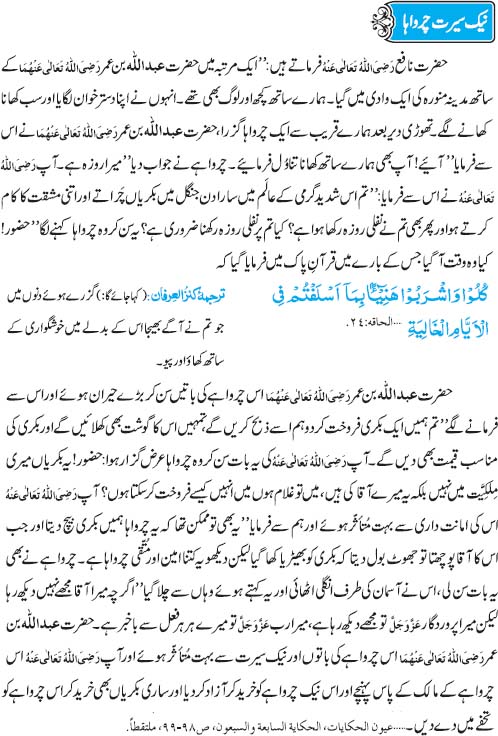
Naik Seerat Charwaha
The Extension Of Islam’s Universal Mercy To Animals
The universal mercy of Islam embraces not only human beings, whether unbelievers, People of the Book, or Muslims but all other living crea of Allah as well. Accordingly, Islam prohibits cruelty to animals. Thirteen hundred years before any societies for the prevention of cruelty to animals were established, Islam had made kindness to animals a part of its faith and cruelty to them a sufficient reason for a person to be thrown into the Fire.
The Prophet (peace be on him) related to his Companions the story of a man who found a dog panting with thirst. The man went down into a well, filled his shoes with water which he gave to the dog, and continued to do so until the dog’s thirst was quenched. The Prophet (peace be on him) said, ‘Then Allah was grateful to him and forgave him his sins.’ The Companions asked, ‘Is there a reward for us in relation to animals, O Messenger of Allah?’ He replied ‘There is a reward in (relation to) every living creature.’ (Reported by al-Bukhari.)
With this radiant picture of Allah’s forgiveness and pleasure, the Prophet (peace be on him) drew another picture depicting Allah’s anger and punishment. He said, A woman was sent to the Fire because of a cat. She imprisoned her and neither fed her nor set her free to feed upon the rodents of the earth. (Reported by al-Bukhari.)
Respect for Allah’s living creatures reached such an extent that when the Prophet (peace be on him) saw a donkey with a branded face, he denounced such a practice saying, “I would not brand an animal except on the part of its body farthest from its face.” (Reported by Muslim.)
In another report, he passed by a donkey with a branded face and said, “Have you not heard that I have cursed anyone who brands an animal on its face or who hits it on its face?” (Reported by Abu Daoud and al-Tirmidhi.)
We have already mentioned that when Ibn ‘Umar saw some people practicing archery using a hen as a target, he said, “The Prophet (peace be on him) cursed anyone who made a living thing into a target.”
Ibn ‘Abbas said that the Prophet (peace be on him) forbade that animals be made to fight each other since people would goad animals into fighting each other until one of them was pecked or gored to death, or close to it. Ibn ‘Abbas also reported that the Prophet (peace be on him) strongly condemned the castration of animals. (Reported by al-Bazzar on sound authority.)
The Qur’an condemned the Arabs of Jahiliyyah for slitting the ears of cattle, calling this a practice inspired by Satan. (4:119)
In relation to the method of slaughtering an animal, we have already pointed out that Islam insists that the manner of slaughter should be that which is least painful to the victim, and it requires that the knife be sharpened but not in front of the animal. Islam also prohibits the slaughtering of one animal in front of another. Before Islam, the world had never witnessed such concern for animals, a concern that was beyond its imagination.
O Allah, O Sufficer of the isolated and weak and Protector against terrifying affairs! Offenses have isolated me, so there is none to be my companion. I am too weak for Thy wrath and there is none to strengthen me. I have approached the terror of meeting Thee and there is none to still my fear. I beg for Your Mercy! Ameen
Waqt Ki Qadar Kijiye
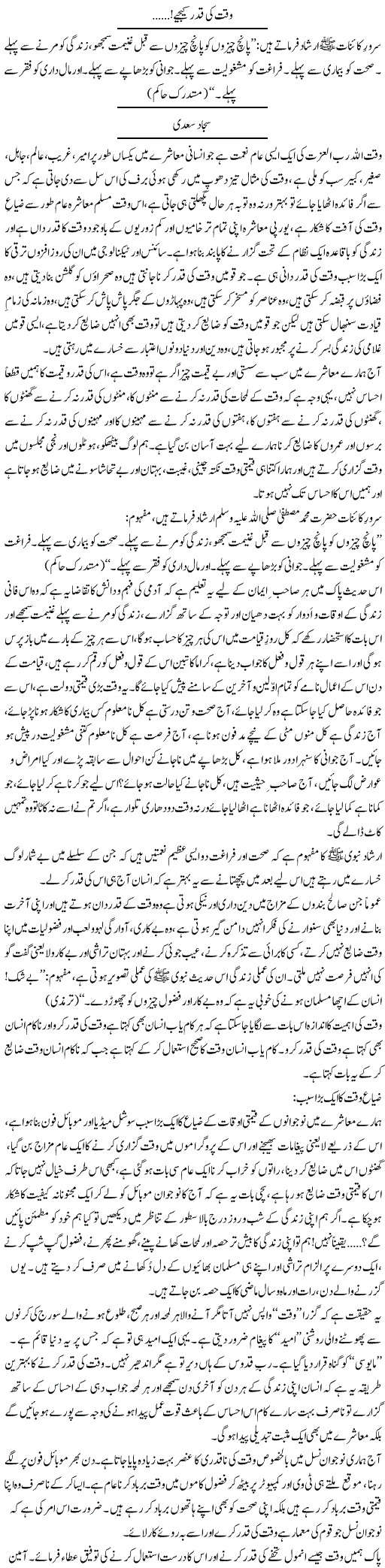
Waqt Ki Qadar Kijiye
Non-Muslim Residents of an Islamic State
Those people who live under the protection of an Islamic government enjoy special privileges. They are referred to as “the Protected People” (ahl al-dhimmah or dhimmies), meaning that Allah, His Messenger (peace be on him), and the community of Muslims have made a covenant with them that they may live in safety and security under the Islamic government.
In modern terminology, dhimmies are “citizens” of the Islamic state. From the earliest period of Islam to the present day, Muslims are in unanimous agreement that they enjoy the same rights and carry the same responsibilities as Muslims themselves, while being free to practice their faiths.
The Prophet (peace be on him) emphasized the duties of Muslims toward dhimmies, threatening anyone who violates them with the wrath and punishment of Allah. He said, “He who hurts a dhimmi hurts me, and he who hurts me annoys Allah.” (Reported by al-Tabarani in Al-awsat on good authority.)
Whoever hurts a dhimmi, I am his adversary, and I shall be an adversary to him on the Day of Resurrection. (Reported by al-Khatib on good authority.)
On the Day of Resurrection, I shall dispute with anyone who oppresses a person from among the People of the Covenant, or infringes on his right or puts a responsibility on him that is beyond his strength, or takes something from him against his will. (Reported by Abu Daoud.)
The successors of the Prophet, the caliphs, safeguarded these rights and sanctities of non-Muslim citizens, and the jurists of Islam, despite the variation of their opinions regarding many other matters, are unanimous in emphasizing these rights and sanctities.
Says the Maliki jurist, Shaha al-Deen al-Qarafi: The covenant of protection imposes upon us certain obligations toward the ahl al-dhimmah. They are our neighbors, under our shelter and protection upon the guarantee of Allah, His Messenger (peace be on him), and the religion of Islam. Whoever violates these obligations against any one of them by so much as an abusive word, by slandering his reputation, or by doing him some injury or assisting in it, has breached the guarantee of Allah, His Messenger (peace be on him), and the religion of Islam. (From the book, Al-furuq, by al-Qarafi.)
And the Zahiri jurist, Ibn Hazm, says: If one is a dhimmi, and the enemy comes with his force to take him, it is our obligation to fight the enemy with soldiers and weapons and to give our lives for him, thus honoring the guarantee of Allah and His Messenger (peace be on him). To hand him over to the enemy would mean to dishonor this guarantee. (From the book, Maratib al-ijma’, by Ibn Hazm.)
Meaning of Friendship with Non-Muslims
A question that troubles some people and which is sometimes discussed openly is the following: How can we show kindness, affection, and good treatment to non-Muslims since Allah Ta’ala Himself prohibits Muslims from taking non-believers as friends, allies, and supporters in such verses as the following: O you who believe, do not take the Jews and Christians as friends; they are the friends (only) of each other. And whoever among you turns to them (for friendship) is certainly one of them; indeed, Allah does not guide the people who do wrong. Yet thou seest those in whose hearts is a disease racing toward them…(5:54-55(51-52))
The answer to this is that these verses are not unconditional, to be applied to every Jew, Christian, or non-Muslim. Interpreting them in this manner contradicts the injunctions of the Qur’an which enjoin affection and kindness to the good and peace-loving peoples of every religion, as well as the verses which permit marriage to the women of the People of the Book, with all that Allah says concerning marriage?” and He has put love and mercy between you” (30:21) and the verse concerning the Christians: …And thou wilt find those who say, ‘Surely we are Christians.’ to be nearest to them (the Muslims) in affection….(5:85 (82)) (The terms Christian and Christianity do not appear in the Christian scriptures nor can they be attributed to Jesus (PBUH) himself. The followers of Jesus were known as Nasara (helpers) and this is the word used in the Arabic text of the Qur’an; the name “Christian” was originally used by those who held the followers in contempt.)
The verses cited above were revealed in connection with those people who were hostile to Islam and made war upon the Muslims. Accordingly, it is not permissible for the Muslim to support or assist them that is, to be their ally nor to entrust them with secrets at the expense of his own religion and community. This point is explained in other verses, in which Allah Ta’ala says: They will spare nothing to ruin you; they yearn for what makes you suffer. Hatred has been expressed by their mouths, but what their hearts conceal is still greater. Thus have We made clear to you the revelations (or signs), if you possess understanding. Ah! You love them, but they do not love you….(3:118-119)
This ayah throws light on the character of such people, who conceal great enmity and hatred against the Muslims in their hearts and whose tongues express some of the effects of such hostility.
Allah Ta’ala also says, Thou wilt not find a people who believe in Allah and the Last Day loving those who oppose Allah and His Messenger, even though they may be their fathers or their sons or their brothers or their kin….(58:22)
Opposition to Allah is not simply belief but includes hostility toward Islam and Muslims.
Allah also says, O you who believe, do not take My enemy and your enemy as friends, offering them affection, even though they have disbelieved in what has come to you of the truth, driving out the Messenger and yourselves because you believe in Allah, your Lord….(60:1)
This verse was revealed in connection with the pagans of Makkah, who declared war on Allah and His Messenger (peace be on him), driving the Muslims out of their homes simply because they said, “Our Lord is Allah.” With this type of people, friendship and alliance cannot be permitted. Yet despite this, the Qur’an did not dismiss the hope that someday there might be a reconciliation; it did not declare utter disappointment in them but encouraged the Muslims to entertain the hope of better circumstances and improved relationships, for in the same surah Allah says: It may be that Allah will bring about affection between you and those who are your enemies from among them. And Allah is All-Powerful, and Allah is Forgiving, Merciful. (60:7)
This Qur’anic statement gives the assurance that this bitter hostility and deep hatred will pass away, as it is also stated in the hadith, “Hate your enemy mildly; he may become your friend one day.” (Reported by al-Tirmidhi. Al-Bayheqi reported it in Shi’ab al-iman from Abu Hurairah. Al-Suyuti called it “good,” transmitting the first part as “Love your friend mildly; he may become your enemy one day.”)
The prohibition against befriending the enemies of Islam is even more emphatic when they are stronger than the Muslims, crushing hopes and generating fear in the minds of people. In such a situation, only hypocrites and those in whose hearts there is a disease hasten to befriend them, giving them help today in order to benefit from them tomorrow. Allah Ta’ala describes this situation as follows: Yet thou seest those in whose hearts is a disease racing toward them (the enemies of Islam), saying, ‘We are afraid that a change of fortune may befall us.’ But it may be that Allah will give (thee) the victory or some decision from Himself, and then they will become regretful for what they thought secretly within themselves. (5:55 (52) )
And again, Give to the hypocrites the tidings that they will have a grievous punishment. Do those who take the unbelievers as friends instead of the Believers seek honor among them? For indeed all honor belongs to Allah alone. (4:138-139)
Seeking Help From Non-Muslims
There is no harm done if Muslims, at either the private or governmental level, seek help from non-Muslims in technical matters that have no connection with the religion for example, in medicine, industry, or agriculture. At the same time, it is of course extremely desirable that Muslims become self-sufficient in all such fields.
We see from the life of the Prophet (peace be on him) that he employed ‘Abdullah bin ‘Uraiqit, a polytheist, to be his guide on his flight (hijrah) from Makkah to Madinah. Scholars have concluded from this that a person’s unbelief does not mean that he is basically untrustworthy, for what could be more risky than depending on a guide to show the route, particularly in fleeing from Makkah to Madinah?
Going considerably beyond this, scholars say that it is permissible for the leader of the Muslims to seek help from non-Muslims, especially the People of the Book, in military matters, and to give them an equal share of spoils with the Muslims. Al-Zuhri reported that the Messenger of Allah (peace be on him) sought help from some of the Jews in a war and gave them a share of the spoils and that Safwan bin Umayyah fought on the side of the Prophet (peace be on him) while still an idolater. (Reported by Sa’id in his Sunan.) The condition for seeking help from a non-Muslim is that he be trusted by the Muslims; otherwise, help may not be sought from him. Since it is prohibited to seek help from unreliable Muslims, such as those who spread rumors and anxieties, this is more true in the case of non-believers. (AI-mughni, vol. 8, p. 41.)
Indeed, Islam respects a human being only because he is human; how much more then, if he is from the People of the Book and still more if he is a dhimmi? Once a funeral procession passed by the Prophet (peace be on him) and he stood up. Thereupon someone remarked, “O Messenger of Allah, it is the funeral of a Jew.” The Prophet (peace be on him) replied, “Was he not a soul?” (Reported by al-Bukhari.)
Thus, truly, in Islam, every human being has dignity and a place.
Musalman Kay Musalman Par Haqooq
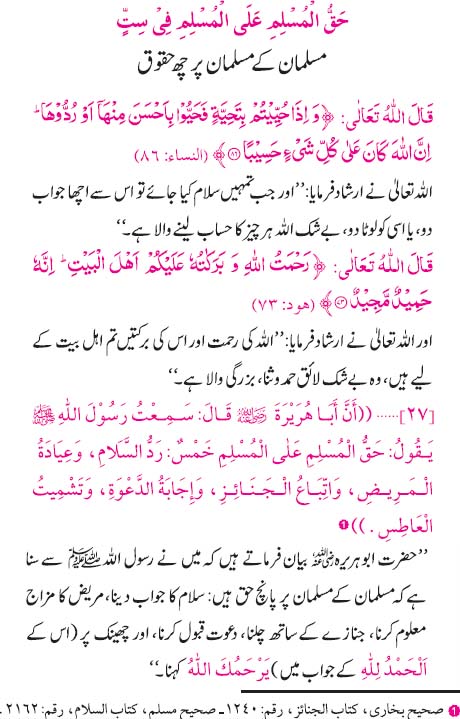
Musalman Kay Musalman Par Haqooq
Social Relationships In Islam
The relations among the members of the Islamic society are based on two fundamental principles: first, awareness of the strong bond of brotherhood which links one individual to another, and second, the protection of the rights of the individual and the sanctity of his life, honor, and property, as guaranteed by the Shari’ah of Islam.
Any words, deed, or behavior that contravenes or threatens these two principles is prohibited by Islam, the degree of prohibition depending on the magnitude of material or moral injury that might result from it. In the following ayat, we find some examples of those prohibited acts which are injurious to the brotherhood and sanctity of human beings.
Allah Subhanahu wa Ta’ala says: Verily, the Believers are brothers. Then set matters right between your brothers and be conscious of Allah in order that you may obtain mercy. O you who believe, let not some people mock at other people, for they may be better than themselves, nor (let) women (mock) at women who may be better than themselves. And do not slander yourselves, nor revile by (offensive) nicknames; evil is a name connoting wickedness after believing; and whoever does not turn away (from doing this), those are wrongdoers. O you who believe, avoid (indulging in) much suspicion; truly, some suspicion is a sin. And do not spy or backbite one another; would any of you like to eat the flesh of his dead brother? You would abhor that. And be conscious of Allah; indeed, Allah is Relenting, Merciful. (49:10-12)
Here Allah proclaims that the Believers are indeed brothers to one another united through the brotherhood of Islam in addition to their brotherhood in humanity. This brotherly relationship requires that they get to know each other and do not avoid each other, that they establish ties and do not break them, that they love and do not hate, that they are sincere and not superficial, and that they come together and do not separate from one another. And the Prophet (peace be on him) says, Do not be envious of each other, nor backbite nor hate one another, but become brothers in the service of Allah. (Reported by al-Bukhari and others.)
Special Consideration for the People of the Book
While Islam does not prohibit Muslims from being kind and generous to peoples of other religions, even if they are idolaters and polytheists, as for example, the polytheists of Arabia, concerning whom the above verses were revealed, it looks upon the People of the Book, that is, Jews and Christians, with special regard, whether they reside in a Muslim society or outside it.
The Qur’an never addresses them without saying, “O People of the Book” or “O You who have been given the Book,” indicating that they were originally people of a revealed religion. For this reason, there exists a relationship of mercy and spiritual kinship between them and the Muslims, all having in common the principles of the one true religion sent by Allah through his prophets (peace be on them all): He has ordained for (the Muslims) the same religion which He enjoined on Noah, and that which We have revealed to thee (Muhammad) and that which We enjoined on Abraham, Moses, and Jesus: that you should establish the faith and make no division in it…. (42:13)
Muslims are required to believe in all the Books revealed by Allah and in all the prophets sent by Him; otherwise, they are not Believers. Say: We (Muslims) believe in Allah and in what He has revealed to us, and in what He revealed to Abraham and Ishmael and Isaac and Jacob and the tribes (of Israel), and in what was given to Moses and Jesus, and in what was given to (all) the prophets by their Lord. We make no distinction between any of them, and to Him do we submit. (2:136)
Consequently, if the People of the Book read the Qur’an, they will find in it praise for their Books, messengers, and prophets.
If Muslims hold discussions with the People of the Book, they should avoid such approaches as cause bitterness or arouse hostility: And do not dispute with the People of the Book except by (the way) which is best, unless it be with such of them as transgress, and say, ‘We believe in what has been sent down to us and sent down to you, and our God and your God is one, and to Him do we submit.’ (29:46)
We have already seen how Islam permits eating with the People of the Book, sharing the meat they slaughter, and marrying their women, marriage being a relationship of mutual love and mercy. As Allah Ta’ala says: …The food of those who were given the Scripture (before you) is permitted to you and your food is permitted to them. And (lawful to you in marriage are) chaste women from among the Believers and chaste women from among those who were given the Scripture before you…. (5:6 (5))
This relates to the People of the Book in general. However, Christians in particular have been given special status by the Qur’an and are considered much closer to the hearts of the Believers.