
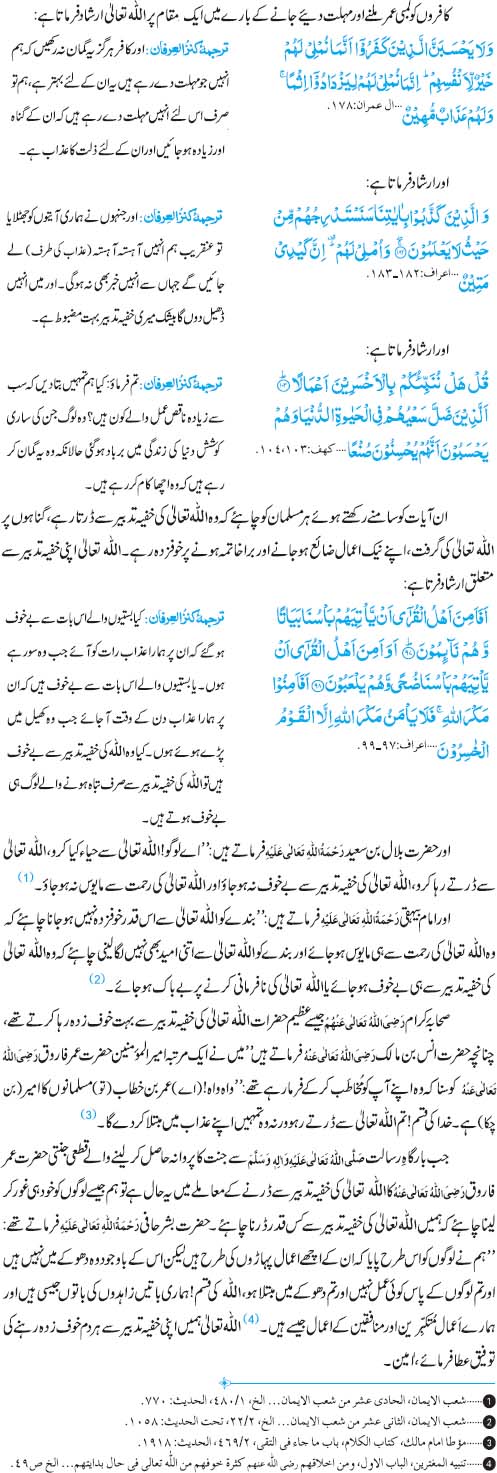
Kafiron Ko Mohlat Diya Jaane Ki Haqeeqat Aur Musalmano Ko Naseehat
Raising Our Boys: Are We Killing Them Emotionally?
What makes a “real man”? What defines what a “real man” should be? This question is vital to the future of our Ummah. But which definition do we really follow? Are we following the definition of a real man of this time? Have we unknowingly buried alive the characteristics of our Prophets and the Sahabah (the Companions)? Who are our children’s heroes? Rock from the World Wrestling Federation?
How can you define who your children’s heroes are? Look at their favorite TV programs, video games, magazines, posters, and movies. Who are their idols? Who do they want to be like? Long are the days when children want to be like their fathers, let alone the Prophets of Allah and the Companions. As though they are just “made-up stories” of long ago.
We need to take a long look into how we raise our boys and what outside influences and pressures are on them. How do we raise our boys, what are we telling them directly and indirectly?
We know only one thing: WE MUST NOT RAISE A WIMP! We are so afraid that our child will be bullied or abused that we learn to shut down their emotionally sensitive side at the earliest age. From watching a mother hold her crying six-month-old baby boy telling him “You’re a big man, don’t cry, you’re a big boy”.
I have seen this over and over again. We have quickly turned the key and locked out our boy’s feelings at an early age. Why? Because we “fear” what others will think of him. Yes, it is normal that we must teach our boys how to defend themselves and help them develop their masculinity. Encourage all of the wonderful characteristics that Allah has given them. Yes, boys will become men, but they are the first Muslims who so vitally have the right to feel and be what a true Muslim man is supposed to be.
The problem is we don’t really know what to do with our boys, we yell at them more than girls if they do something wrong, we beat them for “their own good” instead of talking to them, and we emotionally shut down when they need to talk, we are not there for them when they need a safe place to express their inner most deep feelings and fears, smacking them into humiliation.
We teach them to fear us, not to respect us. We are afraid and are repeating the same child-rearing behaviors that our parents and society have done. We are afraid that we will raise a sissy or an oddball. We are so afraid that we break them down into what we call “boys will be boys” without really thinking about what we are turning our boys into. We shrug our shoulders when we see them pull the legs off a spider; we shake our submissive heads when we see them bully the neighbor’s child secretly happy that he is standing up for himself.
We subconsciously have told our boys that it is their place to yell and discipline their younger siblings as they see fit. In addition, we turn a blind eye and let them play video games where they unmercifully kill and beat cyber women and men to death. Car racing games that allow them to run people over and beat up prostitutes and police officers. (See: Raising Cain, The Culture of Cruelty, by Dan Kindlon and Michael Thompson.)
“Boys are desperate for role models as they head into this uncertain age, and in most cases, the dominant image of masculinity is one that requires strength and stoicism. Among themselves, boys engage in continuous psychological warfare. Older boys pick on younger boys – dominating them by virtue of their greater size – and younger boys mimic them, creating an environment that pits the strong against the weak, the popular against the unpopular, the power brokers against the powerless, and the conformity drive “boy pack” against the boy who fails in any way to conform with the pack expectations.”
What defines our role in raising our boys? The movies, situation comedies, magazines, videos? As Muslims, we have been instructed to raise functionally tuned boys who can both fight to the death (when they have to) and be as kind and compassionate as the most gentle loving man. It is not a conflict of interest; it is an emotionally balanced boy who grows up to be an emotionally balanced man, son, husband, father, brother in Islam, community member, etc.
The ideal Muslim man is a well-rounded man. Nowhere in any religion has the role of a man been laid out like in Islam. Not just some “man’s” opinion, but from the Qur’an, Sunnah, and the Sahabah. Why are we turning our backs on these important characteristics that we are obligated to instill in our boys? Yes we have to deal with the real world, but that is like saying that “the Qur’an, Sunnah and Sahabah are just “idealistic” and not applicable in this world” (This is forbidden to believe the Qur’an, Sunnah, etc. are not applicable, it is for all mankind until the Day of Judgment)
Iman Kay Liay Doo Baray Khatray
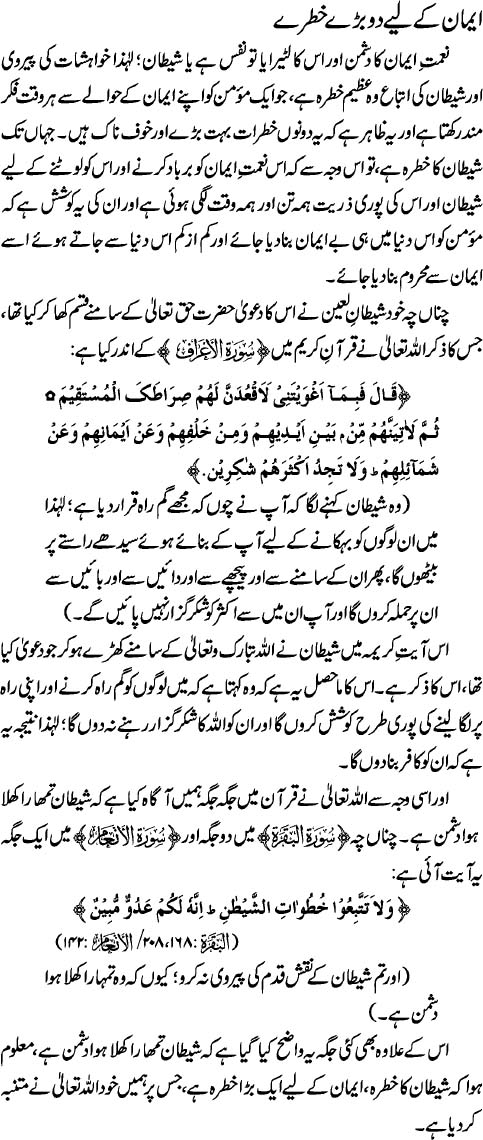
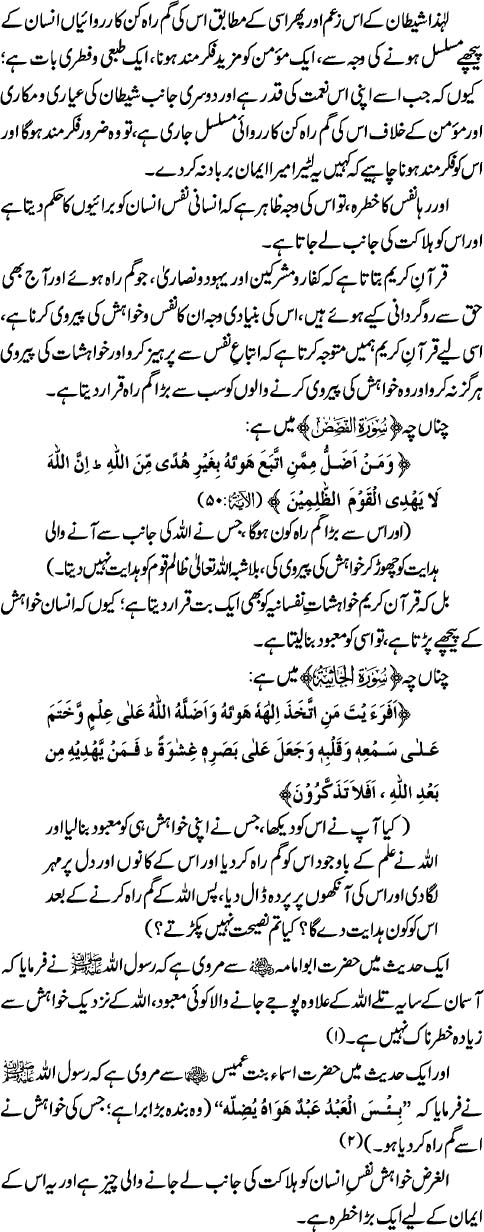
Iman Kay Liay Doo Baray Khatray
Memoirs From The Life Of Imam Ahmad
In an interesting book, Wada’ Ar-Rasul li ‘Ummatihi, Sheikh Al-Qahtani recalls the final words that Prophet Muhammad (peace be upon him) said on his deathbed.
After living a life of ibadah, da’wah, and jihad, the Prophet (peace be upon him) gathered the people around him on his deathbed and said, “I have left two things and you shall not go astray after them so long as you stick to them: the Book of Allah and my Sunnah.”
After the Prophet (peace be upon him) passed away, the Ummah was tested by people who tried to corrupt, discredit, or amputate the Sunnah from Islam. So, Allah – from His Mercy to this Ummah – raised up warriors that would stand in the face of the most vicious enemies of the Sunnah. Among those people that Allah raised was a young boy named Ahmad.
Ahmad lived in Baghdad over a thousand years ago. On cold winter nights, his mother, the blessed Mu’minah that she was, would awake long before Fajr to warm the water for her son. Then, again long before Fajr, she would wake him up to make Wudhu. Then she would wrap him in shawls and off through the molten dark alleys of Baghdad they would carefully make their way to the masjid.
There was no male to escort him (he was an orphan), so Ahmad’s mother would take him that early all by herself so he could get a good seat in the Hadith Halaqa after Fajr. Then she would wait for him long after the sun rose to safely escort him back home. Her son grew up to be one of these warrior defenders of the Sunnah, one of the four Imams of this religion, Imam Ahmad Bin Hanbal.
In his collection, Al-Musnad alone, he narrated from over 280 teachers. He grew up under the shade of the Sunnah and he lived the Sunnah. It was reported that he said, “I’ve never written a Hadith that I did not try to implement.”
He raised his children like this too. When you see other fathers throwing a baseball with their young Muslim children, remember this example: Abdullah, Imam Ahmad’s son, taught his students that when he was young, his father would play with him by saying, “Take any chapter you wish from the Musannaf of Wakee.’ Ask me any Hadith and I’ll tell you the chain of narrators, or tell me any chain of narrators and I’ll tell you the Hadith!”
He was challenged in his religion like few other humans have been challenged. Reading through his life, I came across an event that brought back sad memories. Imam Ahmad once prayed Asr and he sat down with his son in the masjid alone with another man by the name of Muhammad Bin Sa’eed Al-Khuttalee. Al-Khuttalee then remarked, “Did you (O Ahmad) tell the people to boycott Zayd Bin Khalaf?”
Imam Ahmad replied, “I received a letter from his people asking about his affair, so I replied explaining his madhhab and what he has innovated (in the Sunnah) and commanded that they not sit with him…”
Al-Khuttalee exploded in Imam Ahmad’s face, red with anger, “I’m going to make sure you go back to prison. I’m going to have them crush your ribs…”
The vulgarity grew louder and louder. Imam Ahmad turned to his son, “Don’t reply to what he says, and don’t speak to him.” Imam Ahmad took his sandals – Al-Khuttalee swearing from behind his back – and stepped away.
When Caliph Al-Mu’tasim heard that Imam Ahmad did not agree with him and his court Muftis on a specific (but important) issue, they brought him and questioned him in the courtyard of the Caliph. They would debate with him and like a gladiator with a spear, he would hit back with bigger and stronger arguments. The Muftis would shout, “O Caliph, he has committed Kufr!”
Al-Mu’tasim called the executioners. They stripped Imam Ahmad and each of the strongest guards would take turns lashing Imam Ahmad until he fell unconscious. Regardless of his state, they continued the lashing. The sun went down that day and Imam Ahmad had not relented in his faith. That day he became an icon for all followers of Sunnah.
Qutaybah said, “If you ever see someone who loves Imam Ahmad, know that he is a follower of the Sunnah.”
Al-Hasan Bin Arafah narrated that when he visited Imam Ahmad Bin Hanbal after he was whipped and tortured, the Imam told him, “Verily, I saw nothing more than people selling their religion and I saw scholars that were with me sell their faith. So I said to myself, ‘Who am I? What am I? What am I going to say to Allah tomorrow when I stand in front of Him and He asks me if I sold my religion like the others did?’ So I looked at the whip and the sword and chose them.”
Al-Hasan then asked, “Did you feel pain when they whipped you?”
He replied, “Yes, I felt the pain up to 20 lashes then I lost all feeling (they whipped him over 80 times). After it was over I felt no pain and that day I prayed Dhur standing.”
And in fact, he prayed as the blood soiled his clothes.
Al-Hasan ibn Arafah started weeping when he heard what had happened. Imam Ahmad questioned him, “Why are you crying? I did not lose my Iman. After that why should I care if I lose my life.”
Earlier when Imam Ahmad was being led off to the Caliph, people had tried to dissuade him from an almost certain execution. His student, Al-Marrudhi, had told him, “O teacher, Allah says, ‘Do not kill yourselves.’”
Imam Ahmad replied, “O Marrudhi, go outside and tell me what you see.”
Al-Marrudhi went to the wall of the Caliph’s court and saw an ocean of students with their pens and scrolls in their hands. He asked some of them, “What are you waiting here for?”
They said, “We are waiting to see what Ahmad will say and then transcribe it.”
Al-Marrudhi went back to Imam Ahmad and told him what he had seen. “O Marrudhi,” he said, “what shall I gain by misguiding all those people?”
Imam Ahmad lived a life of poverty. He would not even have food to eat. In this life of poverty, hardship, and trials, Abdullah asked his father one day, “My father, when will we ever have a respite?”
His father – one of the greatest revivers of the Sunnah, a role model for all Muslims, whose contribution continues to benefit students a thousand years on – looked him in the eye and said, “With the first step we take into Jannah.”
Fidya Dena Bhi Kuffar Ko Azab Say Bacha Na Sake Ga
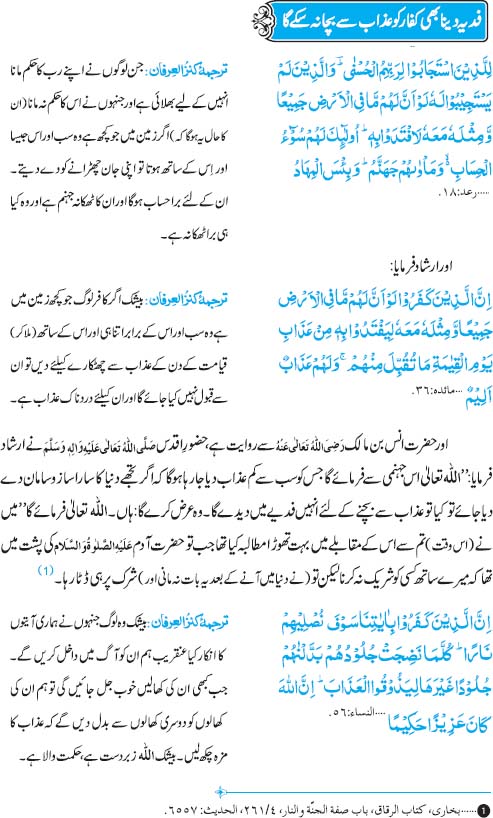
Fidya Dena Bhi kuffar Ko Azab Say Bacha Na Sake Ga
Extract The Honey, But Do Not Break The Hive
Everything that has gentleness within it is beautified, and whatever lacks it is spoiled. When you meet someone, giving them a bright smile and a kind word, you are displaying the characteristic of a truly successful person, a characteristic that even a bee exhibits. When a bee lands on a flower (doing so for a practical purpose) it does not destroy it, because Allah rewards gentleness with that which He does give for harshness. There are certain people whose personalities are like magnets, attracting everyone who is nearby, simply because they are loved for their gentle talk, their good manners, and their noble deeds.
Winning the friendship of others is an art mastered by those who are noble and pious; a circle of people constantly surrounds them. Their mere presence in a gathering is a blessing, and when they are absent they are missed and asked about.
These blessed people have a code of conduct entitled: “Repel (the evil) with one which is better( ie. Allah ordered the faithful believers to be patient at the time of anger, and to excuse those who treat them badly), then verily! He, between whom and you there was enmity(will become) as though he was a close friend.” [Qur’an 41:34]
They suck out malice from others with sincerity, forgiveness, and gentleness. They forget the evil that was enacted upon them and preserve the memory of kindness received. Biting, harsh words may be aimed at them, but such words pass by their ears without entering and continue on their path without ever returning. They are in a state of calmness. People in general, and Muslims in particular, are safe from suffering any harm at their hands.
The Prophet Muhammad(blessings and peace be upon him) said: ” The Muslim is the person whose tongue and hand do not harm others. And the Believer is he, whom others trust, about their blood and wealth.”
He further said: “Verily Allah ordered me to keep relations with those that cut me off, to forgive the one who does injustice with me, and to give to those who withhold from me. ”
The noble Qur’an put it: ” Those who repress anger, and who pardon men; verily, Allah loves the good-doers.” [Qur’an 3:134]
Give to such people glad tidings of a reward close at hand in terms of peace and tranquility. Also, give glad tidings to them a reward in the Hereafter, of gardens and rivers, wherein they will be in close proximity to their forgiving Creator.”
Sharm O Haya: Insaniyat Ka Libas
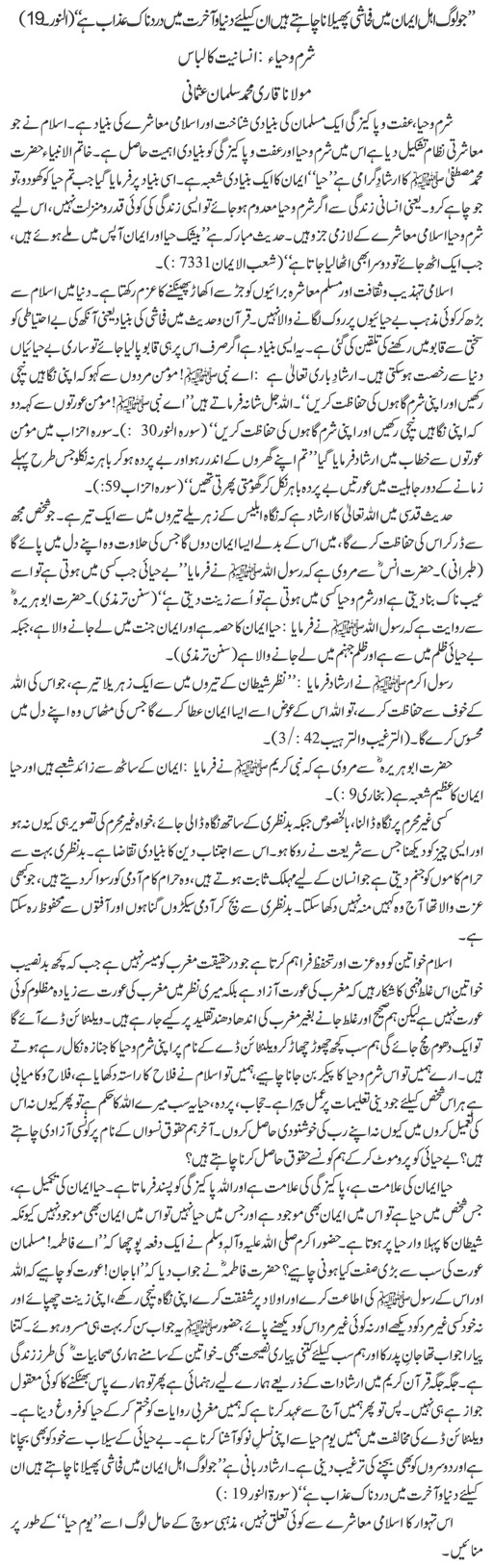
Sharm O Haya: Insaniyat Ka Libas (Valentine Day)
Be Careful About Your Parents
1. Causing grief and sadness to parents
because of a statement or an action: Allah says:- “And your Lord has decreed that you worship none but Him. And that you be dutiful to your parents. If one of them or both of them attain old age in your life, say not to them a word of disrespect, nor shout at them but address them in terms of honor.” (17:23)
Ad-Daylami narrated that Al-Husain Ibn Ali (may Allah be pleased with him) narrated that the Prophet (sallallahu alaihi wa-sallam) said: “Has there been an act of Uquq, less than saying Uff (Fie), Allah would have disallowed it as well.”
Abdullah Ibn Amr Ibn al-Aas (radhi allahu anhu) narrated that a man came to the Prophet (sallallahu alaihi wa-sallam) to give him the pledge of allegiance, saying, ‘I have come to give you my Bai’ah (allegiance) to perform Hijrah (migration to al-Medina). However, I left behind my parents while they were crying.” The Prophet (sallallahu alaihi wa-sallam) said: “Then go back and make them laugh as you made them cry.” [Musnad Ahmad] Furthermore, Ibn Umar (radhi allahu anhu) said: “Bringing tears to parents is a part of Uquq and a major sin.” [Saheeh al-Bukharee]
2. Insulting or Cursing one’s Parents or somebody else’s Parents
Allah’s Messenger (sallallahu alaihi wa-sallam) has cursed him, who insults his parents, he (sallallahu alaihi wa-sallam) said: “Curse be upon whoever reviles his father, curse be upon whoever reviles his mother, Curse be upon on whoever slaughters for other than Allah, Curse be on whoever misguides a blind person on the street, Curse be on whoever does what the nation of Loot did.” [Saheeh al-Jamee (5767)]
And he (sallallahu alaihi wa-sallam) is also reported to have said: “From the major sins is a man reviling his parents.” We (Sahabah) said, “O Messenger of Allah (sallallahu alaihi wa-sallam) and how does a man revile his parents?” He said: “Yes, reviling a man’s father is reviling your father, and reviling his mother is reviling your mother.” [Saheeh al-Bukharee and Saheeh Muslim]
And in another narration, Allah’s Messenger (sallallahu alaihi wa-sallam) replied: “He abuses the father of somebody who, in return, abuses the former’s; he then abuses the mother of somebody who, in return, abuses his mother.” [Saheeh al-Bukharee and Saheeh Muslim] We learn from this Hadeeth that one should not abuse anyone’s parents, because in the event, he is paid in the same coin and he will be responsible for disgracing his parents.
3. Practicing Evil in front of Parents
One should not practice evil in front of parents, such as abandoning prayers, smoking, listening to music, watching indecent movies, and other types of immoral acts. These acts anger parents when Allah has even disallowed even saying Uff to them. If the parents agree with these acts of their child out of love for him, then the parents will earn evil deeds. The child will be committing evil for luring his parents to it, leading them to sin.
4. Disowning and Abandoning Parents
Anas al-Juhani said that his father narrated that the Prophet (sallallahu alaihi wa-sallam) said: “Verily, on the Day of Resurrection, Allah has slaves whom He will neither speak nor purify nor look at.” He was asked: “Who are they, O Allah’s Messenger?” He said: “He who disowns and abandons his parents, he who disowns his children, and he who was granted a favor by a people, but he denied their favor and disowned them.” [Musnad Ahmad]
Refraining from spending on poor parents, forcing them in some cases to resort to courts so that the judge compels the children to spend on them is also a form of Uquq. One should remember that he and all his wealth belong to his father, as known from the following Hadeeth. A man said to the Messenger of Allah (sallallahu alaihi wa-sallam) that he had wealth and children, but his father wanted to use some of his wealth. The Messenger (sallallahu alaihi wa-sallam) replied: “You and your wealth are your father’s.” [Ibn Majah]
5. Preferring the wife over the parents is also part of Uquq
This has certainly become widespread in the present time. This becomes even worse in the case where one prefers his undutiful wife who tries her best to turn her husband away from his father and mother.
6. Refraining from visiting the parents
Not keeping regular contact with them is also a type of Uquq. Al-Bukharee and Muslim narrated that Abu Hurayrah (radhi allahu anhu) said that the Messenger of Allah (sallallahu alaihi wa-sallam) said: “Allah created all the creatures and when he finished the task of His creation, Ar-Raham (the womb ties of relationship) said: ‘(O Allah) at this place I seek refuge with You from all those who sever me (sever the ties of relationship).’ Allah said: ‘Yes. Are you satisfied that I should hold with him who holds you and sever connection with him who severs you.’ It said: ‘I am satisfied.’ Allah said: ‘This is yours.’ Then Allah’s Messenger (sallallahu alaihi wa-sallam) said: “Recite the verse if you like, ‘Would you then, if you were given the authority, do mischief in the land, and sever your ties of kinship? Such are whom Allah has cursed…” [Saheeh al-Bukharee and Saheeh Muslim]
Baad Az Khuda Buzurg Tuee, Qissa Mukhtasar
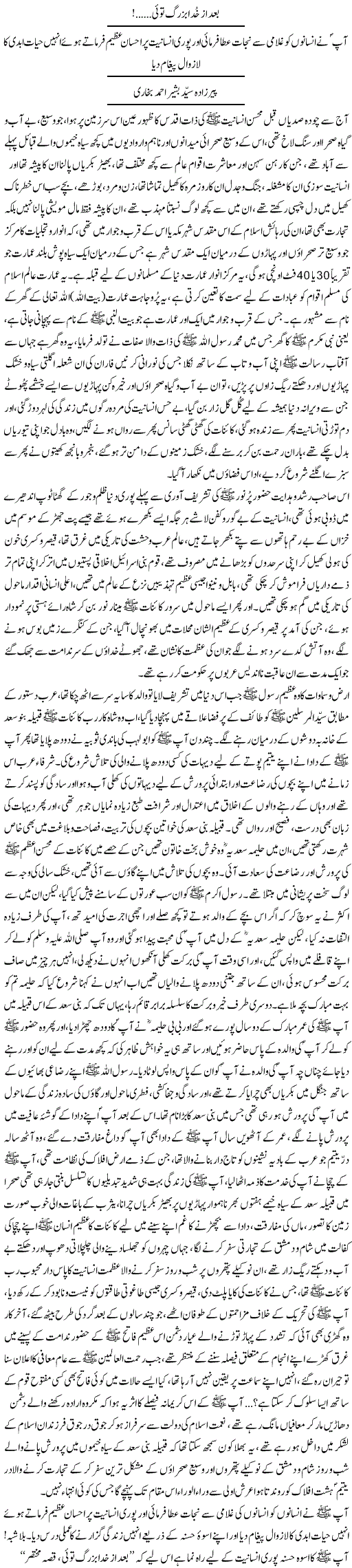
Baad Az Khuda Buzurg Tuee, Qissa Mukhtasar
Selecting A Muslim Name
[1:1] In the name of GOD, Most Gracious, Most Merciful
[7:71] He said, “You have incurred condemnation and wrath from your Lord. Do you argue with me in defense of innovations you have fabricated – you and your parents – which were never authorized by GOD? Therefore, wait and I will wait along with you.”
God Almighty creates all languages, not just Arabic! Any beautiful name can be derived from any language.
[30:22] Among His proofs are the creation of the heavens and the earth, and the variation in your languages and your colors. In these, there are signs for the knowledgeable.
[7:180] To GOD belongs the most beautiful names; call upon Him therewith, and disregard those who distort His names. They will be requited for their sins.
The reason God chose the Arabic language for an Arabian prophet is given below.
[43:2] And the enlightening scripture.
[43:3] We have rendered it an Arabic Quran, that you may understand.
[43:4] It is preserved with us in the original master, honorable and full of wisdom.
[26:198] If we revealed this to people who do not know Arabic.
[26:199] And had him recite it (in Arabic), they could not possibly believe in it.
Some of God’s beautiful English names can be derived from this English translation of the Quran.
[59:22] He is the One GOD; there is no other god besides Him. Knower of all secrets and declarations. He is the Most Gracious, Most Merciful.
[59:23] He is the One GOD; there is no other god besides Him. The King, the Most Sacred, the Peace, the Most Faithful, the Supreme, the Almighty, the Most Powerful, the Most Dignified. GOD be glorified; far above having partners.
[59:24] He is the One GOD; the Creator, the Initiator, the Designer. To Him belong the most beautiful names. Glorifying Him is everything in the heavens and the earth. He is the Almighty, Most Wise.
The Islamic scholars invent all sorts of ridiculous issues (hadith, tafsir,, fatwas, etc,) and successfully divert millions of Muslims from the very important Quranic issues to unimportant unQuranic issues. One of their ridiculous inventions is the “Islamic names” for Muslim boys and Muslim girls.
The word Muslim is an Arabic word that simply means Submitter to God Alone. Anyone who submits to the will of God is Muslim in the Quranic context. According to the Quran, a righteous Jew, a righteous Christian, a righteous Muslim or any righteous person is Muslim in the eye of God(2:62, 5:69).
[2:62] Surely, those who believe, those who are Jewish, the Christians, and the converts; anyone who (1) believes in GOD, and (2) believes in the Last Day, and (3) leads a righteous life, will receive their recompense from their Lord. They have nothing to fear, nor will they grieve.
The Arabic word Islam simply means Submission (to the will of God). So, anyone who follows the religion of Islam is Muslim. The concept of Islam can easily be derived from this verse of the Quran (42:13)
[42:13] He decreed for you the same religion decreed for Noah, and what we inspired to you (Mohammad), and what we decreed for Abraham, Moses, and Jesus: “You shall uphold this one religion, and do not divide it.” The idol worshipers will greatly resent what you invite them to do. GOD redeems to Himself whomever He wills; He guides to Himself only those who totally submit.
The above Quranic verses, along with numerous other verses, confirm the truth that as far as God is concerned, there has always been one religion Islam, which was decreed for Noah, Abraham, Moses, Jesus, and Mohammad. All the scriptures revealed to mankind from God advocate one and the same religion. In this religion God calls Submission or in Arabic Islam.
It is a mistaken concept among Muslim and non-Muslims alike that Islam was founded by Mohammad, who was happened to be an Arab. Satan successfully duped the majority of people on earth including the majority of ignorant Muslims by making them believe that Islam is an Arabian religion or a religion of Mohammad!
Why “Mary” cannot be a good Islamic name for girls!? God Almighty chose her among all the women.
[3:42] The angels said, “O Mary, GOD has chosen you and purified you. He has chosen you from all the women.
[3:36] When she gave birth to her, she said, “My Lord, I have given birth to a girl” – GOD was fully aware of what she bore – “The male is not the same as the female. I have named her Mary, and I invoke Your protection for her and her descendants from the rejected devil.”
Why “Jesus” or “Zachariah” or “Moses” cannot be good Islamic name for boys? The name of Moses is mentioned so many times in the Quran! Jesus was one of those closest to God.
[3:45] The angels said, “O Mary, GOD gives you good news: a Word from Him whose name is `The Messiah, Jesus the son of Mary. He will be prominent in this life and in the Hereafter, and one of those closest to Me.’
[19:7] “O Zachariah, we give you good news; a boy whose name shall be John (Yahya). We never created anyone like him before.”
God and His messenger condemn innovation. God and His messenger condemn division.
[7:71] He said, “You have incurred condemnation and wrath from your Lord. Do you argue with me in defense of innovations you have fabricated – you and your parents – which were never authorized by GOD? Therefore, wait and I will wait along with you.”
[6:159] Those who divide themselves into sects do not belong with you. Their judgment rests with GOD, then He will inform them of everything they have done.
[30:32] (Do not fall in idol worship,) like those who divide their religion into sects; each party rejoicing with what they have.
[42:14] Ironically, they broke up into sects only after the knowledge had come to them, due to jealousy and resentment among themselves. If it were not for a predetermined decision from your Lord to respite them for a definite interim, they would have been judged immediately. Indeed, the later generations who inherited the scripture are full of doubts.