

TAG: Quran
Living And Dying In Islam
The German philosopher Goethe wrote, “If Islam means submission to the will of God, then in Islam we all live and die.” This succinctly summarizes the goal of Muslims: To live and die in accordance with God’s will as revealed in the Qur’an and practiced by the Prophet. Muslims attempt to adjust their view of the world with the lens of the Qur’an. The will of God is expressed in the Qur’an through both expectations and examples. The expectations are usually descriptions of how a believer should live his or her life, and various stories in the Qur’an provide positive and negative examples. The epitome of a positive exemplar is Moses, whose story is dealt with in great detail in the Qur’an. The struggle is at the root of life on earth, a spiritual survival of the fittest. The fittest are those closest to God; they are those who are “steadfast in prayer and spend out of what We have provided for them” (Qur’an 2:3; Ali 1999, p. 17). The negative prototype is embodied in Pharaoh, who elevates himself above God’s law and makes his own law the only source of guidance. Moses is given the Promised Land for his perseverance and steadfastness, and Pharaoh is destroyed by his own hubris and rebellion against the divine will. The story of Moses is an example of submission (Islam), and Pharaoh’s is of rebellion and infidelity (kufr). Between these two lies the struggle of humanity.
Life is meant to be an arena whereby one struggles with good and evil. The Qur’an teaches that good and evil exist in the heart of every individual as well as in society. The individual struggle is to act righteously in accordance with the Qur’an and prophetic example and to shun one’s own evil and its impulses. The collective struggle is to work with others to make the world a more righteous place. In Arabic, this inward and outward struggle is called jihad. While it can mean a militant struggle against those who attack the Muslim lands, it also signifies a person’s struggle with the lower tendencies of the soul, the gravitational pull of self-destructive forces that lead to alienation from God and a state of spiritual disequilibrium. Because humans inevitably fall short morally and succumb to these destructive tendencies from time to time, a means of reestablishing spiritual balance is given, called Tauba or atonement. This is done by experiencing a genuine sense of remorse for one’s transgressions and removal of the unhealthy effects of that state by turning to God and seeking divine grace through prayer, charity, and a sincere resolution not to return to the destructive patterns of the past.
While life is seen as a spiritual test and journey, it is also seen as being filled with blessings from God to be enjoyed: “Eat and drink, but waste not by excess, for God loveth not the wasters. Say: ‘Who hath forbidden the beautiful (gifts) of God which He hath produced for His servants, and the things, clean and pure, (which He hath provided) for sustenance?” (Qur’an, p. 352). Thus, in Islam, marriage is highly recommended and celibacy is frowned upon. The Muslim savants of the past identified sexual relations between a wife and her husband as a foretaste of eternal bliss in the afterlife. The Prophet Muhammad (peace be upon him) encouraged marriage and stated, “There is no monasticism in Islam.” In Islam, children are highly esteemed and seen as one of God’s greatest blessings to humanity. The Prophet stated that humans were born innocent and later corrupted by their societies. Thus, parents are held responsible for maintaining that state of innocence and raising them with a sense of love and awe of the divine. Motherhood is highly regarded in the Qur’an and the prophetic tradition. In most Muslim societies, adult women are still predominantly mothers and housewives during their productive years.
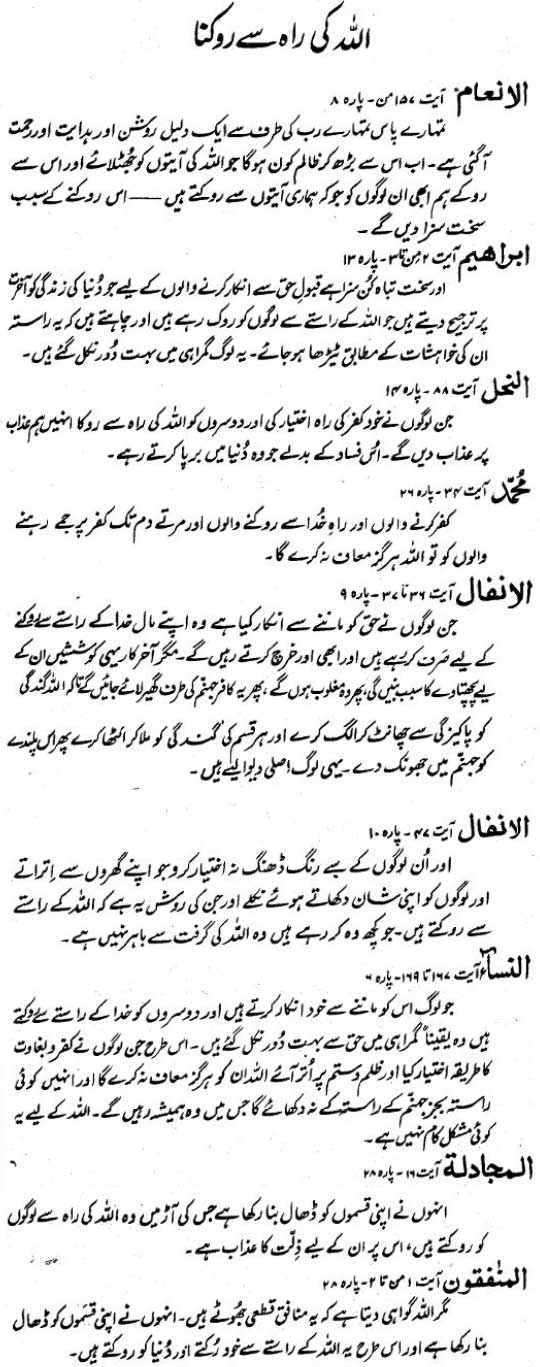
Allah Ki Rah Say Rokna
Building A Close Relationship With The Qur’an
Recite the Holy Qur’an as much as we can for It will come as an intercessor for its reciter’ on the Day of Judgement [Muslim]
Learn the Qur’an and recite it, because the example of one who learns the Qur’an, reads it and recites it in Tahajjud is like an open bag full of musk whose fragrance permeates the entire place. And the person who has learnt the Qur’an but sleeps while the Qur’an is in the heart is like a bag full of musk but with its mouth closed.
Virtues of reciting the Qur’an
“Whoever reads a letter from the Book of Allah will receive a hasanah (good deed) from it (i.e. his recitation), and the hasanah is multiplied by ten. I do not say that Alif-Laam-Meem is (considered as) a letter, rather Alif is a letter, Laam is a letter, and Meem is a letter.” [At-Tirmidhi, Ad-Darimi]
“There is no envy (acceptable) except in two (cases): a person whom Allah has given the Qur’an and recites it throughout the night and throughout the day. And a person whom Allah has given wealth, that he gives out throughout the night and throughout the day.” [Al-Bukhari and Muslim]
It was narrated that Abdullah ibn Mas’ud said: Whoever reads Tabarakallahi Biyadihil Mulk [i.e. Surah al-Mulk] every night, Allah will protect him from the torment of the grave. At the time of the Messenger of Allah (Peace be upon him) we used to call it al-mani’ah (that which protects). In the Book of Allah, it is a surah which, whoever recites it every night has done very well. (an-Nasa’i)
Abdullah Ibn ‘Abbas and Anas Ibn Malik (Ra) reported that the Prophet (Peace be upon him) said, ‘Whoever recited Surah Zilzilah (99) would get the reward of reciting half the Qur’an. Whoever recited Surah al Kaafirun (109) would get a reward as if reading a quarter of the Qur’an. Whoever recited Surah al Ikhlas (112) would get a reward as if reading one-third of the Qur’an’. (At-Tirmidhi 2818/A)
Reading, understanding, and implementing the Qur’an in our daily lives
The virtues of reciting the Qur’an are too numerous to list. In order to get closer to Allah, we need to recite the Qur’an, understand it and implement it in our daily lives.
We should make a target of reading at least a chapter a day. If one can’t manage that then at least half a chapter. If one still can’t manage that then recite at least a quarter of a chapter or even a page a day. However much we can manage we should try to recite each day with its meanings and implement what we learn into our daily lives.
Reading a little each day is better than reciting a lot once in a while. We should build a close relationship with the Qur’an which is in fact building a close relationship with Allah!
“Verily Allah raises nations by this book (the Qur’an) and puts down (i.e. destroys) others by it.” [Muslim]
The Qur’an And The Science Of Stars
The Qur’an is that miraculous book of Allah that brought humanity from the days of ignorance to the age of rationalism. It is that unique and phenomenal book in the history of mankind that opened doors to every science. Allah said, “We shall show them Our signs in the Universe and in their own selves until it becomes manifest to them this the Qur’an is Truth.” (Qur’an, 41:53)
There have been many contentions and theories on scientific subjects by various people around the world, the Qur’an, however, has definite answers to all. It has been readily proven time and again; that many doctors and scientists have accepted that the Qur’an holds answers to all those questions which have been answered by them, recently, with the help of modern technology. As Allah said, “He has taught man which he knew not.” (Qur’an, 96:5)
Some accepted facts about the sun, the moon, and the stars are as follows:
Allah said, “And He has made the sun and the moon, both constantly pursuing their courses.” (Qur’an, 14:33)
When the sun is wound round and its light is lost. And when the stars fall. (Qur’an, 81:1-2)
Then when the stars lose their lights. (Qur’an, 77:8)
Qur’an has mentioned the two theories of science. First, about the movement of the stars, and the second about the end of solar energy. Under the Ptolemaic system, it was said that sunrises and pierces through the sky and the earth is stable. But, this notion was dropped in the 16th century and the theory of Prussian astronomer Copernicus was accepted, who said that the earth revolves around the sun.
It was only after Galileo, an Italian mathematician, that the true nature of the solar phenomenon was recognized. He invented a telescope and observed the rotation of the sun. Thus, what the Qur’an mentioned in the early 17th century was accepted by people in the seventeenth century. “And the sun runs on its fixed course for a term (appointed). That is the Decree of the All-Mighty, the All-Knowing.” (Qur’an, 36:38)
“And by the planets that move swiftly and hide themselves.” (Qur’an, 81: 16)
Scientists also say that the total life of the sun is 10 to the power 10 years, and it will eventually change into black dwarf stars. The Qur’an also confirms the fact that the sun’s light would disappear. They also admit that the death of the sun would be the end of this world — the Day of Judgment will come.
– by Ahmad Wahaj Siddiqui
Muslim College Life: Dating, Drinking and Deen
Freedom. Young people live for the day when they can move out of the house and go to college and finally be free. Freedom from their parents, from restrictions on their lifestyle, from everyone telling them what to do.
This is why in college you find a whole generation that does what they want. Life’s short they say, let’s enjoy ourselves while we can.
So it goes for Muslims. In college, you find the most amazing things, Muslims who don’t pray, Muslims who date, go out to parties, and drink.
Why is this happening?
For one, when students go off to university they finally realize that what they believed in was blind. Religion becomes like a fairytale, when they got old enough, they knew better than to believe in it.
Most have little knowledge about Islam and have maybe memorized the right rituals to get by. Why believe something on faith, they ask. After all, we cannot see heaven or hell. How do we know Islam is right anyway?
Islamic culture to them means marrying someone they never knew. It means arranged marriages and never hanging out or having fun.
For girls Islamic culture has even less to offer. It would mean double standards or having to serve a husband the rest of her life.
The western alternative to this looks a lot more attractive.
In western culture “love and romance” are supposedly everywhere. Everyone is out looking for love freely. Meeting someone, going out, seeking pleasure sounds a lot better.
But what about the downside? For love at first sight, you need to have the right image, the right hair, the right clothes.
Girls have to aspire to be like the latest supermodels, they have to hold back age. Who’s going out with who, what are my friends thinking, what will happen if I don’t get the right girl or guy, what is my girlfriend or boyfriend thinking, all become important.
Frustration, desperation, and unhappiness become the norm.
Imagine all the heartache youth would save if they followed the Islamic alternative.
In true Islam, unlike culture, there is no gameplaying. If two people wish to be involved they are both straight with one another.
Unlike what goes on today amongst some Muslims, they both meet each other and make a contract to marry. Women are treated with respect, there is no sexual bombardment like there is in western society. Sex in western culture is also often seen as a vice or a sin of the flesh. But even in religious Islam, sex is seen as natural. As long as it is in the right circumstances when the two are committed to one another in marriage.
Drinking in college is also the norm, unfortunately. If you don’t drink or party you’re seen as weird. Drinking is cool and a way for people to socialize, meet and have fun. The one who doesn’t is less of a person and ‘misses out’. Drinking and all the harm that comes with it is cut off at the root in Islam. So many problems are avoided, accidents, pregnancy, violence, and even rape for example.
In college and in the world, success in life is not seen in terms of religion. It is seen as what other people think, one’s careers, how much money they make. If you are religious you must have failed at life. But why do we have this separation? and this blindness in religion?
The Quran tells us again and again not to have blind faith, not to follow the religion of our forefathers.
Yet, we as Muslims have stopped thinking. We may think about what our friends or other people will say, but we avoid thinking about the real issues.
We spend so much time on the opposite sex, thinking about careers, money, etc, but we forget to think about death and how much of this we will really be able to take with us?
“Every soul shall have a taste of death and only on the Day of Judgement shall you be paid your full recompense.. .for the life of this world is but goods and chattels of deception”
(Quran 3:185)
Shouldn’t we take the time to contemplate what will happen to us after we hit the grave? After all, what is the point of life if we are not accountable for our actions? If there is no creator, what is the point of being honest or good?
If we really look at our life we see that everything is indefinite, getting a job, even living until tomorrow. In fact, we could die anytime, this is definite, the _only_ dead certain thing in our life.
Most of us believe we can make up for our actions later or we can be religious later.
We are gambling.
The chances of our dying today are little, but the stakes are high. Allah reminds us of the importance of this,
“O you who believe, obey Allah as he should be obeyed, and die not except in a state of Islam”
(Quran3:102)
Each of us needs to decide.
On the Day of Judgement, it will be us alone who will be asked about our actions.
“Verily We have revealed the Book to thee in truth, for (instructing) mankind. He, then that receives guidance benefits his own soul: but he that strays injures his own soul…”
(Quran 39:41)
This is the true definition of freedom. To learn about Islam and the world openly. To contemplate life and death. And after learning the truth, obeying the word of God.
“Those on whom knowledge has been bestowed may learn that the (Quran) is the truth from your Lord and that they believe therein, and their hearts may be made humbly (open) to it…”
(Quran 22:54)
Once students have this rock-solid intellectual belief in Islam, the corruptness and falseness of the people around them are clear. The beauty and wisdom of the Islamic way, the best alternative is clear. What others do is of less importance. If others think they were weird to pray or weird, to be honest, they would still pray and still be honest because they know their deen.
Our Quran’s are left on the top shelves, gathering dust. Sometimes the most it is read is when someone dies. How is this to help, when the guidance comes too late. The Quran is for the living. The path to understanding and following Islam comes from learning first.
How many of us are Muslim, yet have never read the Quran in our native language?
How many of us are Muslim, yet have yet to open a book on hadith or sunnah?
How many of us defend Islam to non-Muslims, but do not follow it ourselves?
May Allah forgive and lead us and all those lost to the straight path.
In Sha Allah.
Ameen.
based on a talk by Abdul Wajid “Born to be Brown”, UK
by Huma Ahmad
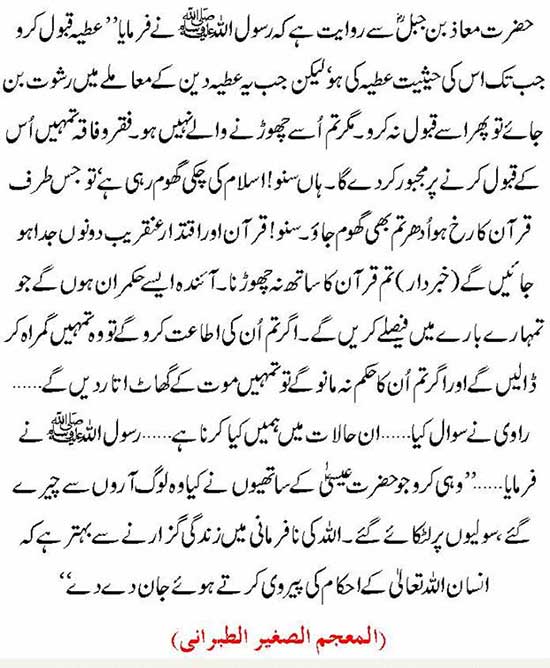
Quran Ka Stah Na Choro
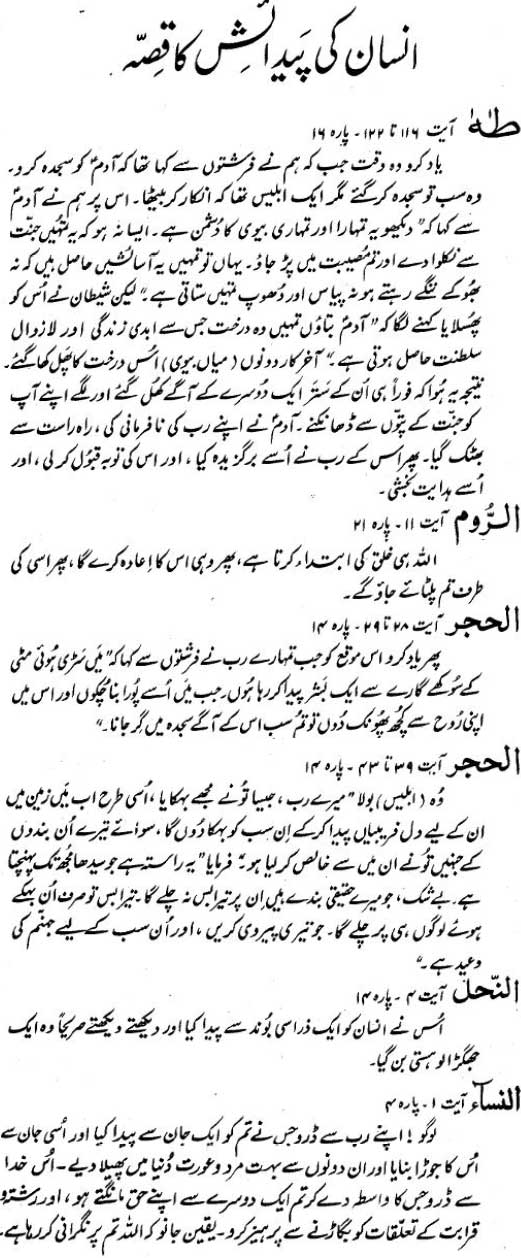
Insan Ki Pedaish Ka Qisa
Learn And Teach Quran
‘And those who, when they are reminded of the verses of their Lord, fall not deaf and blind’ (25:73)
When the blessed servants of Allah are reminded of His verses and the Hereafter, they do not act as if they are deaf and blind. They pay heed to the verses and do not behave like negligent people.
Ibn Kathir has reported on the authority of Ibn Aun that he enquired from Hadhrat Sh’abi that if he comes across people, who are in the state of prostration, was it correct for him to join the people in prostration. Sha’bi replied that it would be incorrect for him to join in their prostration unless he finds out the purpose of the act. It is inappropriate for a believer to engage in any action without knowing the purpose of it.
There is a new tendency amongst the younger generation and modern educated people to study the Quran and deem it enough to seek the understanding of the Quran through its translation. This practice often makes them fall into misconceptions.
It is a fact that education and knowledge can not be acquired simply by referring to books. The guidance of a teacher who is available to explain the intricacies of the subject is necessary to gain a full understanding.
The studying of the Quran without a teacher falls under the aforementioned verse.
Hadhrat Uthman narrates that Rasulullah said: “The best amongst you is he who learns the Quran and teaches it.”
The Quran is the basis of the religion of Islam, and the preservation and propagation of the Quran depend on the very existence of this faith. Hence the virtue of learning and teaching the Qur’an is self-evident and does not need further elucidation.
There are, however, various degrees of excellence. The highest is to learn the Quran along with its meanings and purport, and the least is to learn its words only.
Rasulullah was reported by Hadhrat Sa’eed ibn Saleem “If a person who has acquired knowledge of the Holy Quran considers another person who has been gifted with something else to be more fortunate than himself, he has shown disrespect to the blessings of Allah bestowed on him on account of his learning the Quran.”
Mulla Ali Qari quotes from another Hadith that whoever acquires the knowledge of the Holy Quran stores the knowledge of Prophethood in his forehead. Sahl Tastari says that the proof of love for Allah is the existence of love for the Word of Allah in one’s heart.
In ‘Sharhul Ihya, the list of people who will be given shelter in the shade of the Throne of Allah on the fearful Day of Judgment includes those persons who teach the Quran to the children of Muslims and also those who learn the Holy Quran in their childhood and are devoted to its recitation when grown up.
May the Almighty include us amongst these people. (Ameen)