

Hazrat Zaid Bin Sabit (radi Allahu anhu) Ka Hifz e Quran
Ascribing Associates To Allah, the Most High (Shirk)
The worst major sin is Shirk. It is of two kinds:
a) To hold that Allah has an equal, whereas He has created you, and to worship another with Him, whether it be a stone, tree, sun, moon, prophet, sheikh, star, angel, or other. This is the greatest shirk mentioned by Allah, the Most High, the Almighty, says, {Allah forgiveth not (the sin of) joining other gods with Him; but He forgiveth whom He pleaseth other sins than this; one who joins other gods with Allah hath strayed far, far away (from the right).} (An-Nisa: 16)
{False worship is indeed the highest wrongdoing.} (Luqman:13)
{Whoever joins other gods with Allah, Allah will forbid him the Garden, and the Fire will be his abode.} (Al-Ma’idah:72)
The Qur’anic verses concerning this are very numerous. Certainly, whoever ascribes associates to Allah and
Ahl-e-Iman Ki Baz Sifaat
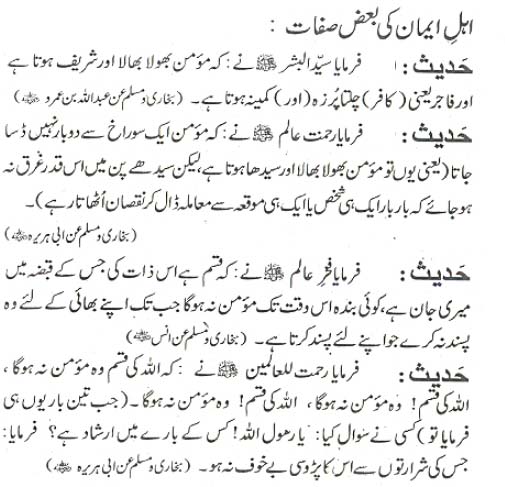
Ahl-e-Iman Ki Baz Sifaat
Major Sins
Major sins are defined as those forbidden by Allah and His Messenger in the Qur’an and the Sunnah, as well as what is narrated on the authority of early Muslims. Allah, the Most High, promises whoever avoids the major sins to expiate his minor sins. Allah, the Almighty, says, {If you avoid the major sins forbidden to you, We will absolve you of your lesser misdeeds and admit you into a place of honour.} (An-Nisaa: 31)
In this text, Allah, the Most High, also promises whoever avoids the major sins to admit him to Paradise. Allah, the Almighty, says, {Those who avoid the greater sins and indecencies, and when they are angry, even they forgive;} (Ash-Shura:37)
The Qur’an also states, {Those who avoid great sins and indecent deeds, save lesser offences, verily thy Lord is ample in forgiveness.} (An-Najm:32)
The Prophet (peace be upon him) said, “The five prescribed prayers, and from one Friday prayer to another
Bait Allah Ki Ziarat Par Maghfirat

Bait Allah Ki Ziarat Par Maghfirat. Hajj Aur Hijrat Zirya Maghfirat
Syedinna Abu Bakr Siddique radiallahu taala anhu’s Love Towards The Ahle Bayt
The Sahabas are the stars in the sky. Their lives are examples to the travelers, a true example of the love, respect, and following of the Holy Prophet Muhammad (Sallalaahu Alaihi wasallam) and the utter submission to his command by both body, heart, and soul.
The Ahle bayt is like a boat we must enter. The spiritual legacy of the Holy Prophet Muhammad (Sallalaahu Alaihi wasallam) continued through his progeny (Ahle bayt) to the Awliya Allah. All the Sufi chains descend from the progeny of the Holy Prophet Muhammad (Sallalaahu Alaihi wasallam).
Only the people who take the boat and also follow the stars will succeed. The Brightest Star is Abu Bakr
Kalma Tayyaba Ki Tasdeeq

Kalma Tayyaba Ki Dil Say Tasdeeq Par Jahanum Haram
Sayings Of Prophet Muhammad (Sallallahu alaihi wasallam)
Increasing good deeds during the first ten days of Dhul-Hijja
It is narrated on the authority of ‘Abbaas (may Allah be pleased with him) from the Prophet sallallahu ‘alayhi wa salam that he said, “There is no action done in days better than these.” They said, “Not even jihad?” He said, “Not even jihad except a man who risks his life and wealth and returns with neither.” [al-Bukhari: 969]
Killing domestic lizards (wazghah)
It is narrated on the authority of Abu Hurayra (may Allah be pleased with him), who said the Messenger of Allah (sallallahu ‘alayhi wa salam) said, “Whoever kills a domestic lizard with the first blow will have one hundred good deeds written for him, and if on the second less than that, and if on the third less than that.” [Muslim 8547]
Prohibition on narrating everything one hears
It is narrated on the authority of Hafs bin ‘Aasim (may Allah be pleased with him), who said the Messenger of Allah,
Sallallahu ‘alayhi wa salam, said, “It is sufficient as a sin for an individual to narrate everything he hears.” [Muslim 7]
Intending to reward by spending on the family
It is narrated on the authority of Abu Mas’ood al-Badri (may Allah be pleased with him) that the Prophet sallallahu
‘alayhi wa salam said, “If the Muslim spends upon his family expecting reward for it, it is charity by him.” [Muslim 2322]
Trotting (raml) during circumambulation
It is narrated on the authority of Ibn ‘Umar (may Allah be pleased with father and son), who said: When the Messenger of Allah (sallallahu ‘alayhi wa salam) did the first circumambulation, he trotted for the first three and walked for the four others. [Agreed upon: 1644 – 3048]
Persistence in a righteous action, even if small
It is narrated on the authority of ‘Aa`ishah (may Allah be pleased with her) that she said, “The Prophet sallallahu ‘alayhi wa salam was asked what action is most beloved to Allah.” He said, “The most constant, even if small.” [Agreed upon: 6465 – 1828]
Tauba Kay Maani

Tauba Kay Maani
Some Sayings Of Prophet Muhammad (Sallallahu alaihi wasallam)
Prophetic practices of the natural human state (fitra)
It is narrated on the authority of Abu Hurayrah (may Allah be pleased with him) that he said: The Messenger of Allah sallallahu ‘alayhi wa salam said: “The natural human constitution is five [or five things are from the natural human constitution]: circumcision, shaving the pubic hairs, plucking the armpit hairs, trimming the nails and shortening the moustache.” [Agreed upon: 5889 – 597]
Caring for orphans
It is narrated on the authority of Sahl bin Sa’d (may Allah be pleased with him) that the Prophet sallallahu ‘alayhi wa salam said: “I and the carer of the orphan are like this in paradise.” He demonstrated with his finger and middle finger. [al-Bukhari: 6005]
Avoiding anger
It is narrated on the authority of Abu Hurayra (may Allah be pleased with him) that a man said to the Prophet sallallahu ‘alayhi wa salam: “Advise me.” He said, “Don’t get angry.” He repeated it a number of times. He said,