
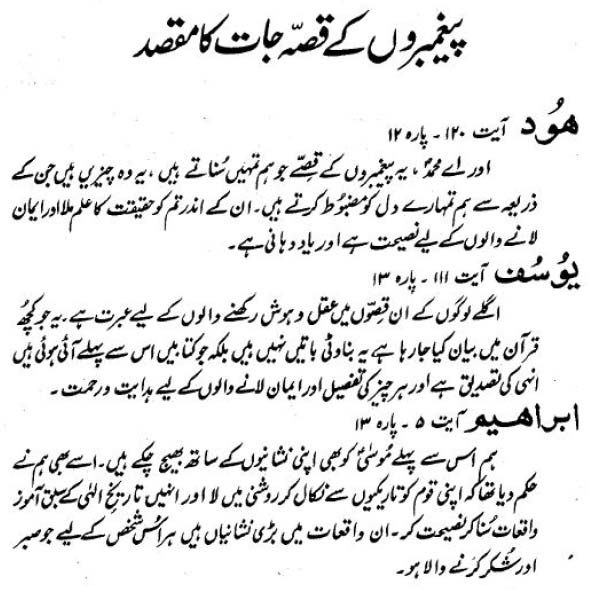
Paighambron Kay Qissa Jaat Ka Maqsad
Not Performing The Prayer
Allah, the Most High, says, {But after them there followed a posterity who missed Prayers and followed after lusts soon, then, will they face destruction, except those who repent and believe, and work righteousness.} (Maryam: 59-60)
Commenting on the above verses (Ayat), Ibn ‘Abbas (radi Allahu anhu) said, “Allah’s statement, ‘Who missed Prayers does not mean that they did not perform it at all, but rather they did not perform it in its due time.”
Sa’id Ibn AI-Mussaiyyib, Imam of the Tabi’een (may Allah be pleased with him) said, “It is he who postpones the Dhuhr (Early Afternoon Prayer) until the time of Asr Prayer (Late Afternoon Prayer) and so are Maghrib (Sunset Prayer) until’ /sha’ (Evening Prayer), /sha until Fajr (Dawn Prayer) and Fajr until the sun rises. If someone dies
Allah Ta’ala Say Doorie Ki Aik Misal
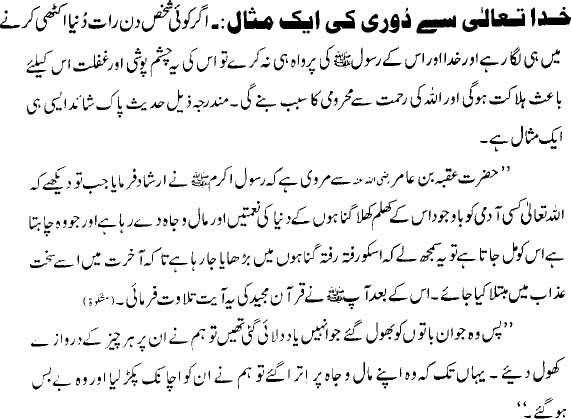
Allah Ta’ala Say Doorie Ki Aik Misal
Major Sin: Sorcery
Sorcery is a major sin because the sorcerer must necessarily disbelieve in the accursed Devil, who has no other motive for teaching a person witchcraft than that he might thereby ascribe associates to Allah.
Allah, the Almighty, says, {Solomon did not disbelieve, but Satan disbelieved, teaching men magic, and such things as came down at Babylon to the angels Harut and Marut. But neither of these taught anyone (such things) without saying, ‘We are only for trial, so do not blaspheme.’ They learned from them the means to sow discord between man and wife. But they could not harm anyone except by Allah’s permission. And they learned what harmed them, not what profited them. And they knew that the buyers of (magic) would have no share in the happiness of the Hereafter.} (AI-Baqarah: 102)
Thus, you might find some people who are astray, delving into learning sorcery and thinking that it is just
Tauba Kay Barey Mein Farman-e-Khudawandi

Tauba Kay Barey Mein Farman-e-Khudawandi
Love Your Parents
A Mother’s Labour Of Love
No one can deny the supreme sacrifice and care that a mother renders to her child. The mother carries him (in her womb) by enduring strain after strain. And subsequently, at the time of birth, she is suspended between life and death. All this she faces with determination as much as patience, barring any regret or anger.
After the child is born, the mother looks after him and brings him up with enormous love. She breastfeeds him for as long as two years, after which she continues to look after her child with all sincerity, regardless of the
Hazrat Umar Ka Daur-E-Khilafat

Hazrat Umar Ka Daur-E-Khilafat
Killing A Human Being
Allah, the Almighty, says, {If a man kills a believer intentionally, his recompense is Hell, to abide therein (for ever); and the wrath and curse of Allah are upon him, and a dreadful chastisement is prepared for him.} (An-Nisa:93)
{Those who invoke not, with Allah, any other god, nor slay such life as Allah has made sacred, except for just cause, nor commit fornication,’ and any that does this (not only) meets punishment.} (Al-Furqan:68)
{On that account: We ordained for the children of Israel that if anyone slew a person -unless it be for murder or for spreading mischief in the land -it would be as if he slew the whole people.} (AI- Ma’ida:32)
{When the female (infant), buried alive, is questioned for what crime she killed.} (Al- Takwir: 8-9)
Sahaba radi Allahu anhum Ka Allah Say Mulaqat Ka Shoq

Sahaba: Abu Huraira , Ameer Muawiyah, Abdullah ibn az-Zubayr (radi Allahu anhum) Ka Allah Say Mulaqat Ka Shoq
Virtues Of The Ahl al-Bayt: A Means Unto The Revival Of The Dead Soul
All praise is to Allah, the Lord of Creation. The Most Gracious, the Most Merciful. Owner of the Day of Recompense. Who blessed us, being the Ummah of His Beloved Rasool Sallallaho Alaihi wa Sallam. Who sanctified our hearts with the Love and Affection towards His Beloved Rasool Sallallaho Alaihi wa Sallam. Who blessed us with the most precious treasure of Iman (Faith). Countless Salutations, Peace and Blessings of Allah be upon the Cream of the Creation; Mercy for all Worlds; Seal of the Prophets Sayyiduna wa Mawlana MuHammadur Rasoolullah Sallallaho Alaihi wa Sallam, His Blessed Parents, His entire Family, His Progeny, His Companions and all those who Follow Him!!
Allah SubHanuhu wa Ta’ala says in the Holy Qur’an: “Say (O dear Prophet Mohammed – peace and blessings be upon him), do not ask any fee from you upon this, except the love between close ones” [Surah al-Shoora, Verse 23]
Sa’eed bin Mansur, in his Sunan, narrates from Sa’eed bin Jubayr Radi Allahu Ta’ala Anhu, He said: “In this verse, close ones refers to the relatives of the Prophet SallAllaho Alaihi wa ala Aalihi wa Sahbihi wa Baaraka wa Sallam. [Jami’ al-Bayan, Vol. 11, Page 144 | Zakhair al-‘Uqba, Page 33, Durr al-Manthur, Vol. 5, Page 701 | Sahih al-Bukhari, Vol. 3, Page 288]
This reveals that love for the Muslim relatives of the beloved Prophet through either blood or marriage is obligatory (Fard) upon every Muslim, neglect of which will prompt questioning by Allah SubHanuhu wa Ta’ala.
The following are a few out of many sacred and blessed Ahadith containing the virtues of the Ahl al-Bait al-Kiraam Alaihim ar-Ridwan, and thereby reveal the rank of the beloved Prophet’s Ahl al-Bait and relatives.